Red-Hot Resources

"Luck is not chance, it’s toil; fortune’s expensive smile is earned.”

Tuesday, August 19, 2008

Crude Oil -- Supplies Will Fall Short of Demand

This story in the New York Times is getting some talk on the trading floor today. Here's a quote ...
In 1994, the top five oil companies spent 3 percent of their free cash on share buybacks and 15 percent on exploration. By 2007, they were spending 34 percent of their free cash on buybacks — in effect, propping up their share prices — and a mere 6 percent on exploration, according to figures compiled by a team led by Ms. Jaffe and Ronald Soligo of Rice University. As a result, some experts warn that supplies will fall short of the demand over the next decade, perhaps sending prices well above today’s levels.

Also of interest ...
Export Boom Helps Farms, but Not American Factories
All exports of goods and services in the first half of the year rose at a $52 billion annual rate, adjusted for inflation, up 7.1 percent. Commodities accounted for 41 percent of the increase and manufactured products contributed just 12 percent, the bureau reported.

And then there's the inflation number that everyone is talking about ...

Wholesale Prices Surge at Fastest Pace Since 1981
The Labor Department reported that wholesale prices shot up 1.2 percent in July, pushed higher by rising costs for energy, motor vehicles and other products. The increase was more than twice the 0.5 percent gain that economists expected.

Labels: , ,

Check out my new gold and energy blog at MoneyAndMarkets.com

Monday, August 18, 2008

Charts of the Dollar, Gold and More

The dollar is running the show, and its rally should weigh on commodities in the short term.


And now some news you can use ...

ENERGY

OPEC official says output cuts may be needed
An Iranian official in the Organization of Petroleum Exporting Countries said Saturday that the producers group is considering leaving oil production levels unchanged or perhaps even trimming them to shore up flagging prices and defend market share. "The market is oversupplied by at least 1 million barrels a day. If OPEC would like to remove this additional oil out of the market, then OPEC has to cut some production," OPEC governor Mohammad Ali Khatibi told Dow Jones in a telephone interview.

Crude Oil: Supply and Demand Prospects
Despite the high prevailing prices, demand in 2008 is expected to total 86.9 million barrels compared to 85.96 mb/d in 2007. For 2009, global oil demand is expected to reach 87.7 mb/d.

Did you hear that Alaska has more oil than the Middle East?

Busting the myths about cheap and unlimited oil being broadcast by Rush Limbaugh, Jerome Corsi and other ignoramuses.

Goldman Cuts U.S. Natural Gas Price Forecast 23% Citing Higher Production Goldman Sachs Group Inc. cut its U.S. natural gas price forecast for the Northern Hemisphere winter by 23 percent because of higher-than-expected output and lower demand from power plants.

ECONOMY

Bracing for Inflation
Growing evidence suggests American consumers, businesspeople, and political leaders should all be bracing for double-digit inflation, probably as early as 2009. The skyrocketing price of oil is obviously a central element in the accelerating price spiral. But a sea change in China's role is beginning to have a huge impact as well.

US Banks Scramble To Refinance Long-Term Debt
Battered US financial groups will have to refinance billions of dollars in maturing debt over the coming months, a move likely to push banks’ funding costs higher and curb their profitability, say bankers and analysts.

The banks’ need to raise capital to offset mounting credit-related losses is forcing them to pay higher interest rates to entice investors.

CHINA

China raises tax on big cars to curb pollution
But cars with an engine size of between 1 and 2.5 liters, which account for nearly 90 percent of the world's second-largest car market, will have their tax rate unchanged.

Labels: , , , , ,

Check out my new gold and energy blog at MoneyAndMarkets.com

Tuesday, July 08, 2008

Is Gold Ready for Blast-Off, and Other News

Oil price shock means China is at risk of blowing up

The manufacturing revolution of China and her satellites has been built on cheap transport over the past decade. At a stroke, the trade model looks obsolete.

The Next President’s First Task

Today, we don’t need to abolish carbon as an energy source in order to see its inefficiencies starkly, or to understand that this addiction is the principal drag on American capitalism. The evidence is before our eyes. The practice of borrowing a billion dollars each day to buy foreign oil has caused the American dollar to implode. More than a trillion dollars in annual subsidies to coal and oil producers have beggared a nation that four decades ago owned half the globe’s wealth. Carbon dependence has eroded our economic power, destroyed our moral authority, diminished our international influence and prestige, endangered our national security, and damaged our health and landscapes. It is subverting everything we value.

Higher gas prices? Florida company bets on it

The company, MyGallons, charges members an annual fee of $29.95 or $39.95. Members buy gasoline gallons via a web site (www.mygallons.com) at a predetermined average price for the area where they live. The gallons are loaded onto a debit card that the company says is accepted at more than 95 percent of the nation's fueling stations.

Gas Stations Hit Skids

Far from profiting from climbing gasoline prices, station operators are finding that their costs are jumping even as gasoline sales are sagging. And so gas stations are being shuttered at an accelerating clip, their numbers dropping by almost 3,000 over the past 12 months.

My latest interview on HoweStreet.com. As usual, Phil and I have a great time talking about this and that.

Uranium Advances for a Second Week as Demand Doubles

Uranium gained for a second week as demand doubled, outpacing supply for the first time this year, Denver-based pricing service TradeTech LLC said. Uranium-oxide concentrate for immediate delivery climbed to $60 a pound, $2 more than a week before, TradeTech said in a July 4 report. Two sales of about 225,000 pounds took place last week, it said. Demand doubled to more than 3 million pounds of uranium oxide from a week before and supply held at 2.4 million.

TIPS Flunk Inflation Test as Fuel, Food Overtake CPI

Treasury Inflation Protected Securities aren't living up to their name for bond investors who say they can't trust the way the U.S. government calculates the rising cost of consumer goods.

Labels: , , , ,

Check out my new gold and energy blog at MoneyAndMarkets.com

Wednesday, July 02, 2008

Could We Rally Despite Bad News?

We should see Wall Street start off with a nice rally this morning, though I won't place a bet on where the day ends. Markets are terribly oversold and yesterday's action ended in a bullish reversal on high volume at support -- that's VERY bullish.
And yet we seem to get more terrible news all the time ...

BAD NEWS FOR THE CONSUMER ...

Auto sales plunge

June auto sales plunged, according to reports from the nation's major automakers, as Americans shunned pickups and SUVs in the face of record gas prices. General Motors reported that its U.S. sales fell 18% in June versus a year ago. Sales of GM's light trucks, which includes pickups, SUVs and so-called crossovers, tumbled 16%. GM's car sales dropped 21% in the month.

BAD NEWS ON INFLATION ...

Manufacturers struggle to overcome rising prices

NEW YORK - Each week, Ira Cooper opens a letter from another supplier with the same message as the last: We're raising our prices, effective immediately. We can't tell you how long the new prices will last.

"We used to get quotes good for six months," said Cooper, president of QED Inc., a lighting company based in Lexington, Ky. "Now you're lucky if you can get a quote good for 15 days."

Manufacturers of everything from wallpaper to cereal are feeling the same hit. The Institute for Supply Management said Tuesday that its index of prices manufacturers pay for raw materials hit 91.5 in June, up from 87 in May and the highest reading since 1979.

BAD NEWS ON WEATHER

African disturbance 92L could develop into tropical depression AND US Midwest floods show impact of global warming

Labels: ,

Check out my new gold and energy blog at MoneyAndMarkets.com

Wednesday, June 25, 2008

Charts and News for Wednesday

Slate has a good story on Peak Oil with lots of stats: Barrel Fever.

Personally, I can't wait to see what the International Energy Agency comes up with in its comprehensive assessment of the world's top 400 oil fields. From last month's Wall Street Journal ...

For several years, the IEA has predicted that supplies of crude and other liquid fuels will arc gently upward to keep pace with rising demand, topping 116 million barrels a day by 2030, up from around 87 million barrels a day currently. Now, the agency is worried that aging oil fields and diminished investment mean that companies could struggle to surpass 100 million barrels a day over the next two decades.
And here's today's news ...
Oil falls as crude supplies rise

Light, sweet crude for August delivery fell more than $3 to less than $134 a barrel on the New York Mercantile Exchange. Oil had been trading down $1.30 before the report's release. The U.S. Energy Information Administration's weekly petroleum report showed that oil supplies rose by 800,000 barrels during the week ended June 20. Economists had expected supplies to fall by 1.7 million barrels last week, according to Platts information service.

Japan's Exports Grow 3.7% as Asian Shipments Offset US Slump Japan's exports grew at twice the pace economists estimated in May, as accelerating shipments to Asia helped the economy withstand a slump caused by falling demand from the U.S. and Europe.

Fed May Begin Shift to Fighting Inflation as Rate Cuts Help Sustain Growth The Federal Reserve may signal today that inflation is starting to replace a recession and the credit crunch as the biggest risk facing the economy.

Sean's note -- I'll believe that when I see it.

Labels: , ,

Check out my new gold and energy blog at MoneyAndMarkets.com

Tuesday, June 17, 2008

News You Can Use for Tuesday

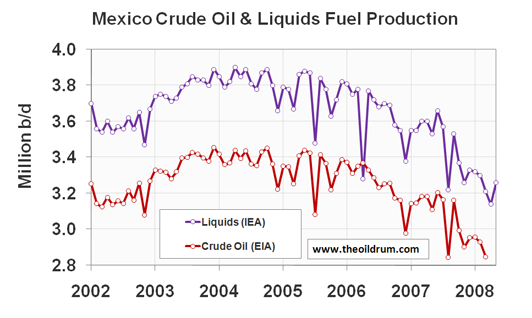
Chart of the Freakin' Day ...


Mexico is the world's No. 6 oil producer and a key U.S. crude supplier but Pemex's oil output has declined this year due to waning yields at the aging Cantarell oil field and technical problems at wells in recent weeks.

The sheer hypocrisy of this debate on oil
Meanwhile the US Senate has threatened to launch a prosecution of OPEC for its alleged fixing of the world oil market, to the detriment of the American consumer. The American legislature's hypocrisy in this matter takes a different form to ours: the politicians who are now howling with rage about the shortage of oil supply are in essence the same people who have long blocked the oil industry from developing vast deposits both in the Arctic National Wildlife Refuge and off their own coastline - about 80 per cent of the US continental shelf is out of bounds, on environmental grounds.

Crude Oil Drops for Third Day on Concern Economic Slowdown May Curb Demand Crude oil fell for a third day on signs that slower economic growth in the U.S. and Europe will curb fuel consumption.

Nymex Oil Futures Price Averaged Over 200 Days Exceeds $100 for First Time Oil prices averaged over 200 days surpassed $100 a barrel for the first time on the New York Mercantile Exchange, an indication of the durability of a rally threatening global economic growth.

More News You Can Use

Stocks in US Show Negative Return on Inflation Gain
Surging commodity prices have eroded earnings and spurred the Federal Reserve to consider raising borrowing costs just as equities are trading at their most expensive in four years. Standard & Poor's 500 Index shares yield 0.22 percentage point more in profits than the interest on 10-year Treasury notes, the smallest advantage since 2004, data compiled by Bloomberg show. The last time corporate earnings returned less versus bonds, the index posted its first quarterly decline in more than a year.

The 39 percent advance in oil, 61 percent jump in corn and 41 percent climb in rice pushed the UBS Bloomberg Constant Maturity Commodity Index to a record this year. That's squeezing profits as raw-material costs outpace consumer prices by the largest margin since the 1970s. Companies in the S&P 500 will earn 7.7 percent less in the second quarter than a year ago, according to analysts' estimates compiled by Bloomberg.

Dollar Falls as Housing Decline Raises Bets Fed Will Delay Rate Increases The dollar fell against the euro after a government report showed housing starts dropped in May to a 17-year low, raising speculation the Federal Reserve will delay increasing borrowing costs this year.

Corn Advances Near to Record in Chicago as U.S. Crop Conditions May Worsen Corn traded close to a record on speculation the U.S. crop will suffer further damage from floods in the Midwest, potentially reducing production in the world's biggest producer and exporter.

US Wholesale Inflation Increased More than Forecast
Producers paid 7.2 percent more for goods from May 2007, compared with a 6.5 percent gain in the 12 months ended in April. Excluding food and energy, the increase was 3 percent from a year earlier, the same as in the prior month.

More on the rise in producer prices HERE.

China's Factory, Property Investment Climbs 25.6%
Urban fixed-asset investment rose to 4.03 trillion yuan ($585 billion) in the first five months from a year earlier, the statistics bureau said, after gaining 25.7 percent in the four months through April.

Labels: , ,

Check out my new gold and energy blog at MoneyAndMarkets.com

Thursday, June 05, 2008

Scorching Hot Food Inflation

Today, we are seeing the US dollar go up and gold go down. That's interesting, considering that inflation is nowhere near tamed.

U.S. Agriculture Secretary Ed Schafer: " We are anticipating this year an over 40 percent increase in food price inflation globally, 43 percent approximately." Schafer added: "Of that we can identify two to three percent of that price increase that is driven by biofuels."

So Mr. Schafer says something to scare the pants off us -- 43% food inflation. The same number was cited by Edward Lazar, chairman of the Council of Economic Advisors, in his testimony to the Senate last month. Most people seem to have missed that.

At the same time, Schaefer's 2% to 3% figure for biofuel-caused inflation sounds bogus. So what can we believe?

If you believe the IMF, the shift of crops out of the food supply to produce biofuels accounts for almost HALF of the recent increases in the global food prices.

Here's a fact: 25% of total US corn production was dedicated to ethanol in 2007. Now, you can argue that if it weren't for ethanol, farmers wouldn't be planting all that corn. Maybe the truth is somewhere in the middle between the IMF and the USDA. In any case, inflation is hot and getting hotter.

We have already seen the Reuters/University of Michigan Surveys of Consumers gauge of five-year inflation expectations rise to 5.2%. That's the highest since February 1982, when even beleaguered consumers couldn't grasp how high inflation really was. The actual consumer inflation rate at the time was above 7%.

Mr. Schafer says much of the world faces 43% food inflation, but here in America, the world's breadbasket, things aren't that bad ... yet. At the same time that global food inflation clocked 43% (the 12 months ending in March 2008), US food inflation was just 4.5%.

On an annual basis, U.S. food prices rose 4% in 2007, compared with an average 2.5% annual rise for the last 15 years, according to the U.S. Department of Agriculture.

But prices keep accelerating. Slate explains that food inflation in the US is now running at a 9% annual rate, up from the normal 2%:
Food already eats up about 14 percent of the typical American's household budget. By Rosenberg's reckoning, Americans sticking to their regular diets are paying an extra $25 billion per quarter compared with last year.
Food, Fuel and the Tax Rebate

Along with food prices, energy inflation is also squeezing consumers. Energy inflation is so bad that 17.2 million tax-refund recipients plant to use some of the money to buy gasoline.

American companies are already lining up to siphon those tax rebates for the high cost of groceries. Kroger grocery stores have set up programs that permit people to exchange stimulus checks for gift cards with a 10 percent bonus.

The tax rebate is going to be worth about $120 billion. The combination of food and fuel inflation will cost Americans an extra $50 billion in just the current quarter. You do the math -- we'd have done much better to keep a lid on prices and skip the tax rebate.

But I don't think the government can keep the lid on prices. That genie is out of the bottle.

Bottom line: I think the move higher in the US dollar and down in gold is short-term, and due to the jawboning by Fed Chairman Ben Bernanke and rotation by fund managers and others. I think the longer-term trend will be much higher. It's likely this pullback will give us a chance to do some bargain hunting.

Labels: , ,

Check out my new gold and energy blog at MoneyAndMarkets.com

Monday, June 02, 2008

News You Can Use for Monday -- Gold, Agriculture, and More

COMMODITIES

Bank Commodity Derivatives Rise to $9 Trillion, 1.5% of Total Outstanding Commodities derivatives held by banks expanded 27 percent last year to $9 trillion as declining raw- material supplies and lower interest rates buoyed investor demand, according to International Financial Services London.

Institutions Money Drives up Commodities

In the last five years, investment in index funds tied to commodities has grown from $13 billion to $260 billion, and the price of the 25 commodities that compose those indices have jumped 183 percent, according to congressional testimony from Michael Masters, managing member of the Virgin Islands-based hedge fund Masters Capital Management.

Rio Tinto says demand will surge through 2022

Rio Tinto and Joy Global both gave bullish prospects for the mining industry, saying they stand to benefit from ravenous demand from China, India and elsewhere.

Rio Tinto, Big Coal Won't Spend Billions to End Climate-Changing Pollution Rio Tinto Group and U.S. utilities are urging the government to spend $20 billion on a technology they say has the best chance for eliminating pollution linked to global warming.

India Rules Out Higher Oil Subsidies, Signaling Gasoline Prices May Rise India's Prime Minister Manmohan Singh said subsidies can't be allowed to rise any further, indicating his government may increase fuel prices capped since February.


Sinopec to halt oil products exports
"Sinopec will raise production, halt exports and adjust product structure to ensure domestic supply, especially for the reconstruction after the earthquake, the summer harvest and the Olympic Games," said Sinopec President Wang Tianpu.

Australian quarterly gold output plunges to lowest level in 19 years
At 53 tonnes, Australia's first-quarter gold production showed a 16% drop on the previous quarter's figure, and was 12% lower year-on-year.

AGRICULTURE

Soybeans Fall as Argentine Farmers to Decide on Tax Protests; Corn Slides Soybean futures fell in Chicago as Argentine farmers are poised to decide whether to extend more than two months of protests against higher agricultural export taxes. Corn fell and wheat extended gains.

Corn, Soybeans May Rise as Rains Threaten to Harm U.S. Crops, Delay Sowing Corn and soybeans may rise on speculation rains this week will flood Midwest fields, delaying seeding of the two biggest U.S. crops or harming young plants.

ECONOMIES AND CURRENCIES

Russian 2008 Inflation May Accelerate to 14%, Threatening Growth, IMF Says Russian inflation may accelerate to 14 percent this year and the risk of the economy overheating is mounting, an International Monetary Fund official said.

Paulson Says Financial-Market Turmoil Will Last `Months,' Supports Dollar U.S. Treasury Secretary Henry Paulson said it will take ``months'' before financial-market turmoil ends and that he ``very strongly'' supports a strong dollar.

CHINA

Brilliance China Gains Most in Eight Months on Introduction of New Model Brilliance China Automotive Holdings Ltd., the local partner of Bayerische Motoren Werke AG, rose the most in eight months in Hong Kong trading on expectations a new model would boost earnings.

XX Note -- subscribers to my Asia report from last year will remember Brilliance Austomotive as one of the picks.

Labels: , , , , , ,

Check out my new gold and energy blog at MoneyAndMarkets.com

Monday, May 26, 2008

Uh-Oh! Gulf States May End Currency Peg to US Dollar

We hear from Bloomberg that both the United Arab Emirates and Qatar could abandon their currency pegs to the U.S. dollar in favor of a basket of currencies within months, and Saudi Arabia may follow the move late next year. They would all be following the lead of Kuwait, which last year broke from its neighbors and fixed its dinar to a basket of currencies.

Why are the Gulf States doing this? Thanks to surging energy prices, Gulf nations are experiencing an unprecedented boom, and an increasing inflation problem. Yet their currencies are depreciating and their central banks are under pressure to cut their nominal interest rates to match the Fed.

Plainly, the US Fed's easy money policy does not work for them. Even though many investors believe the US interest rate easing cycle is at an end -- futures on the Chicago Board of Trade showed traders saw a 92% likelihood the Fed will keep its target rate for overnight lending between banks at 2% on June 25, up from odds of 88% on May 21 -- it's too little, too late for the Gulf states.

What's more, Forbes quotes Deutsche Bank and others as saying that the Fed may NOT be through cutting rates, and may drop the benchmark from an already low 2%.

Continued cuts in the Fed benchmark rate could grease an already slippery slope for the US dollar. Since the Fed cut rates from 5.25% to 2% since last August, wholesale inflation has increased to 6.5% year over year and the price of oil has soared to over $130 from $70. A global supply/demand squeeze for distillates like diesel gets much of the credit, but the meteoric rise in oil prices wouldn't have happened without the Fed's help. If the value of the US dollar had just held steady since August, the price of oil would be under $90 a barrel.

And as bad as inflation is, it's probably much worse than the government admits. ShadowStats.com is a website that tracks the Consumer Price Index the same way it was before the Clinton administration started monkeying around with it. And according to ShadowStats, consumer price inflation is running at more than 3 full percentage points hotter than the government says. Would the government lie to you? Hahahahaha!

And this is my long-winded way of getting to my subject: Gold and silver prices. It seems that foreign governments, especially those in the Persian Gulf, are losing their faith in the almighty dollar and the policies of the US government. That undercuts the mighty greenback's standing as the world reserve currency. Now, that doesn't mean your dollars become worthless overnight. But the more its reputation gets chipped away, the faster its downward slide can become. I think this has the potential to heat up the fires under gold and silver quite a bit.

If paper money becomes devalued, people will put more faith in hard currencies. More and more Moms and Pops put a few gold and silver coins away "just in case," and the trickle we see in gold and silver coin investing now can become a flood. And thus we learn from the Wall Street Journal that d
emand is simply overwhelming the supply of US Silver Eagles. Why are so many "early movers" suddenly buying silver coins. What are they afraid of?

As the old saying goes, if you have to ask that question, you haven't been paying attention.

Labels: , ,

Check out my new gold and energy blog at MoneyAndMarkets.com

Tuesday, May 13, 2008

News You Can Use -- Oil, Inflation and More

IEA Cuts 2008 Oil Demand Forecast for Fourth Month
The forecast was cut by 390,000 barrels a day to 86.84 million barrels a day, from 87.23 million barrels last month, the Paris-based agency said today in its monthly report. After today's revision, which "may not be the last,'' the group expects world consumption to grow 1.2 percent this year, the slowest expansion since 2006.

XX Note -- at the same time it was predicting oil use would go down, the IEA asked OPEC to pump more oil. If I was in OPEC, I'd be wondering what the IEA guys are smoking.

Also, the IEA’s new
Oil Market Report is out this morning. April world oil supply was down 400 thousand barrels per day from March to 86.8 million barrels per day. And April's production was also down 700 thousand barrels per day from the high in February.

Average gas prices set record at $3.72 a gallon
The average price of gasoline jumped to $3.722 a gallon, the government said Monday, up a hefty 10.9 cents in a week and the fourth consecutive record. Diesel, the fuel of semi trucks, delivery vans and railroad locomotives, shot up 18.2 cents to $4.331 per gallon, guaranteeing higher shipping costs that could boost the price of everything from TVs to tostadas.


U.S. import prices up 1.8% in April as petroleum gains
The price for imported petroleum rose 4.4%. The price for non-petroleum products rose 1.1% for the second consecutive month -- matching the largest one-month gain for the index since these prices were first published on a monthly basis beginning in December 1988.

XX Note -- the real story -- barely covered in most mainstream media outlets -- is that year-over-year import price inflation was literally off the charts in April, up a stunning 15.4%. This is the fastest rate of import price inflation in recorded history

Nissan Plans Electric Car in U.S. by 2010
In another deal -- maybe a test run for its US roll-out -- Nissan teamed with Renault to sell electric cars in Israel and Denmark. Renault will provide the cars and Nissan will supply lithium-ion battery packs.

It's a Small-Car World
Here is a neat gallery of the small cars that are coming to the American market in the next couple years. Unfortunately, CNN doesn't include the gas mileage on each of these.

One disappointment that is indicative of how deeply American car makers are screwing themselves is this one ...

Opel Agila

Not just a concept, the Agila will go on sale in Europe soon. Opel cars are sold in the U.S. as Saturns, but GM has no plans introduce the Agila here.

Yeah, GM is showing the brilliance and forward thinking that American car manufacturers are known for.

Steel once again a hot commodity
Don't expect additional supplies of steel to ease the situation, Parr says. There are a few new steel mills coming online, but there's still nowhere near the capacity to meet the current level of demand, Parr says. "We're five years into this," he says. "Basic materials cycles last decades."

Gold Drops as Dollar's Rebound Curbs Investment Demand for Precious Metal Gold declined for the second straight day as the dollar rebounded against the euro, curbing demand for the precious metal as an alternative investment. Silver also fell.

Labels: , ,

Check out my new gold and energy blog at MoneyAndMarkets.com

Friday, April 11, 2008

Six Stories That Will Move the Market Today

1) GE's poor outlook is weighing on stock futures -- at this point, Dow futures are down over 100 points.
General Electric Profit Declines 12% on Finance Unit; Annual Forecast Cut General Electric Co. said first- quarter profit fell 12 percent, missing analyst estimates, because it couldn't complete asset sales and had higher-than- expected losses at its finance businesses due to disruptions in global capital markets. GE cut its full-year forecast.

2) Boris Schlossberg writes about some of the whipsaw forces driving currencies ...

Most of the dollar crosses have started to consolidate ahead of the G-7 meetings as a number of initiates to restore stability to the financial system will be bantered about. Monetary leaders are expected to weigh a number of ideas to provide additional liquidity to the markets and create measures to prevent recent problems from repeating in the future. New BoJ governor Shirakawa is expected to steer the talks toward restoring the dollar’s strength, as his country has been negatively impacted by its recent depreciation. However, don’t expect the U.S. and European countries to support those efforts, as Kathy Lien wrote in Why G-7 meetings matter.

And yes, the G-7 is meeting.

3) The China problem isn't going away, and the surge in China's currency reserves could push the US government to further weaken the US dollar (in a misguided attempt to improve our trade balance with China)
China's Foreign-Currency Reserves Surge 40% to $1.68 Trillion on Inflows China's foreign-exchange reserves, the world's largest, surged to $1.68 trillion at the end of March, adding pressure on the government to prevent money inflows from fueling inflation already at an 11-year high.

4) The mortgage crisis continues to spread overseas.
S&P Cuts Rating on $4.6 Billion of Australian, New Zealand Mortgage Bonds Standard & Poor's lowered the credit ratings on about A$5 billion ($4.6 billion) of Australian and New Zealand residential mortgage-backed securities in the first cut to the nations' home loan bonds from the U.S. housing collapse.

5) Global inflation continues to worsen.
India to Scrap Export Incentives on Rice, Steel as Inflation Accelerates India scrapped export incentives for rice, steel and cement to boost local supplies and tame runaway inflation, which is damping consumer demand for manufactured products.

6) We are one bad harvest away from a global food crisis.
Philippines Seeks Wheat `All Over' After China Turns Down Export Request The Philippines said China turned down a request to supply wheat, adding to concern that the world faces a worsening shortage of staple foods that has already driven grain prices to records.

Labels: , , ,

Check out my new gold and energy blog at MoneyAndMarkets.com

Friday, January 11, 2008

Ben Bernanke Wants to Make You Rich

Yesterday, Ben Bernanke said he was ready to make deeper cuts in interest rates. This is good for Red-Hot Canadian Small-Caps and Red-Hot Global Small-Caps in three ways.

  1. This is naturally inflationary, so that should boost prices of precious metals.
  2. It's also bad for the US dollar, so it will boost the value of US shares of foreign stocks.
  3. Finally, this should juice up the US economy, which is still the most powerful engine in the global economy. And that should increase global demand for natural resources.

Why is Mr. Bernanke doing this? Well, he can't ignore the signs of a slowing economy anymore.

First, the numbers are in, and holiday sales were terrible: An already weak holiday shopping season turned out to be even worse than expected for many of the nation's retailers, who reported Thursday they had disappointing sales results for December. The poor performance raised more concerns about consumer spending, and in turn, the health of the economy.

Adjusted for inflation, December retail sales dropped about 2% compared to last year.

Next up, credit card borrowing surged: The Federal Reserve reported Tuesday that consumer borrowing climbed at an annual rate of 7.4% in November, far higher than the 1% rise in October.

The category that includes credit card debt surged at an annual rate of 11.3%, a six-month high, an indication that shoppers were relying heavily on credit cards to finance purchases since home equity lines of credit became harder to get....The 11.3% rise in credit card debt was the seventh straight month of strong gains in this area and was the biggest jump since a 12.8% rise in May.

So consumers had to max out their credit cards even though they bought less than last year.

In a consumer-driven economy – which is what the US is – this is bad news.

More bad news: U.S. manufacturing contracted in December and sits near five-year lows, while hiring in December rose by 18,000, the least since August 2003. Also, profit growth for S&P 500 companies turned negative in the third quarter for the first time since 2002 and is projected to be negative again in the final three months of 2007.

And this bad news isn't confined to the US. European retail sales in November fell the most in at least a decade, and U.K. house prices declined 0.8 percent in the fourth quarter, the first drop since 2000.

Taking these things into consideration, you can see why Bernanke is eager to cut interest rates. The markets are starting to price in not just a 50-basis point cut in interest rates but ANOTHER 50-basis point interest rate cut after that.

The fact is, the Fed and the Treasury are just not going to sit on their hands and let the economy go into the tank in an election year. They are going to STIMULATE the heck out of the economy.

However, it's not like inflation is cooling down. Did you see the US trade deficit figures today? Not only were the headline numbers bad, but US import prices posted their largest calendar-year increase on record in 2007 as oil prices climbed over 50%!

What's more, China used to be a deflationary offset to higher domestic prices. But that's not happening anymore.

The real bad news: In 2007, import prices soared 10.9%, way, way up from the 2.5% gain registered in 2006. What's more, that's the highest calendar-year increase since the government began compiling the data in 1987!

Obviously, inflation is red-hot. And lower interest rates will only make it hotter. Obviously, this makes the value of the US dollar go down. And what goes up when the dollar goes down … what's on the end of the fabled "See-saw of pain" ….

That's right, amigos! Gold!

Naturally, silver will go up, too.

But wait – there's more!

Along with lower interest rates, Central Banks around the world have been throwing billions and billions of dollars (and euros) at the banking crisis. That crisis could cost banks $400 billion, and the government will likely pick up the tab. That means you and I pick up the tab, but on the upside, a government bailout will likely jumpstart bank lending again. On top of that, now the Bush administration is considering a "stimulus package" of undetermined size. $100 billion is a number being tossed around.

You think things will change if the Democrats win the election? Well, Hillary Clinton is already pushing a $70 billion stimulus package.

All this liquidity has to flow somewhere. I bet a big chunk of it flows into gold, and other parts of it keep flowing to emerging markets which produce the oil that America is addicted to like high-speed chicken feed and places like China and India which make the goods we buy on credit.

Let's not focus on who foots the bill right now. Let's just admit this is like crank for the global economy.

So, to sum up: Gold and silver going up. US dollar going down. US shares of foreign stocks going up. Demand for natural resources going up.

Now, the big stocks are down this morning. But most of the stocks in the Red-Hot Canadian Small-Caps portfolio are rising. The Red-Hot Global Small-Caps portfolio got clocked overnight, but don't worry, that was an over-reaction -- it should play catch-up tomorrow.


Why is your Canadian portfolio rising? Because those stocks are focused in the right sectors (natural resources) and the easy money policy being pushed by the government will make buyouts and takeovers top of the menu in 2008. The big fish will start circling these stocks soon -- you wait and see.

I'm getting more bullish on the right sectors.

2008 could be one heck of a year.


Labels: , , , , ,

Check out my new gold and energy blog at MoneyAndMarkets.com

Friday, December 21, 2007

I Do Not Think That Word Means What You Think It Means

My title is a famous line from The Princess Bride, but it also applies to this dumbass take on personal spending from the Washington Post ...

Consumer Spending Surges in November
Consumers opened their wallets wider than expected as the holiday shopping season kicked off in November, boosting retail sales by the largest monthly amount in more than three years and helping Wall Street start the day on a strong note.

Sounds pretty good, right? Well, maybe you should read a little further ...
Incomes also rose in November, by 0.4 percent, double the rate of increase in October, although that was more than offset by increased prices, the department reported. Discounting for inflation, disposable personal income — the money left to spend after taxes — fell 0.3 percent (emphasis added).


So the fact is, incomes did NOT rise in November. Real income is the only income that matters, and real income was down. That's the number that should get the attention.

And while we're at it, that 1.1% increase in consumer spending that's in the first paragraph of the story? Also not adjusted for inflation. The real number is 0.5%.

And the primary driver of that 0.5% increase in consumer spending? Since incomes were down I suppose you can guess the answer, but you have to plow through to the tenth paragraph before the Post actually tells you: "The increase in spending came because consumers either borrowed or dipped into savings. The department reported that personal savings declined by more than $48 billion in November."

Labels: ,

Check out my new gold and energy blog at MoneyAndMarkets.com

Wednesday, December 19, 2007

It's Not a Credit Crisis, It's a Solvency Crisis

I read this story in the Financial Times a few days ago and I keep coming back to it ...

Hold tight, the central banks have no plan

This has been the year when many deeply held beliefs have been challenged. One such belief was that central banks have the toolkit to sort out any conceivable economic or financial crisis.

Last week’s co-ordinated liquidity action by five central banks taught us that this is not the case. The idea was that a co-ordinated response would reassure the markets, but it had the opposite effect. It turned out that market participants are not infinitely stupid. They know by now that this is not a liquidity crisis at its core. If it had been, it would be over by now.

It is a fully fledged solvency crisis that has arisen because two giant and interlinked bubbles burst simultaneously – one in property, one in credit – leaving banks and investors on the brink of bankruptcy, some hanging on by their fingertips. Yet there is nothing the central banks are offering at this stage to alleviate a solvency crisis.

Go read the whole thing.

And this brings me to my point. I've said in the past week that the market is wrong if it thinks the Fed is going to stop cutting interest rates because of rising inflation. The Fed may stop cutting interest rates, but I think the folks in Washington don't want to stop inflation. Inflation is the only way they can get America out of the housing crisis.

Here in Florida, homes that were selling for $500,000 a year ago are selling for under $400,000 now. If Joe and Jill Consumer take that kind of hit, they're going to scream bloody murder.

But let's say you get inflation of 8% per year. Then the price people are willing to pay for that house has artificially inflated back to $500,000 in just three years.

You don't think inflation will run at 8%? Okay, let's say 5%. Then it will take you five years to get back to the original price of the home.

You could make a case that the powers that be in Washington are trying to encourage enough inflation in the economy generally that home prices will start inflating by 5% a year. That way, homeowners who sell their houses will feel they haven't lost money, even though, thanks to inflation, they really have.

It's just a theory, but one I'm comfortable with.

Labels: ,

Check out my new gold and energy blog at MoneyAndMarkets.com

Wednesday, November 14, 2007

Today's PPI Numbers

The Producer Price Index clocked a 0.1% rise in October, which was less than expectations of 0.3%. However …


There was something funky with the gasoline number. Gasoline prices fell 3.1%, which must have been a quirk of when the data was collected – that is, it must have missed the big rise that started at the end of October. I can tell you that gasoline prices are certainly rising now.


And the year-over-year rise in headline PPI was 6.1%, versus 4.4% in September. That means the annualized pace of PPI growth has hit a 2 year high! Look at this chart I’ve made of the year-over-year rise in the headline producer price index. That sure looks inflationary to me.


Producer prices ex- food and energy (the core number) looks tame, but looking at prices without food and energy doesn’t work for me. Show me someone who lives without consuming food or energy.


Still, the stock market futures are reacting very postively to this number, because traders this PPI number gives the Fed more room to cut interest rates in December.


If the Fed follows the market’s wishes (the probability of a quarter point rate cut next month is 80%), that means more downward pressure on the US dollar. And THAT should mean more upward pressure on gold and silver.

Labels: ,

Check out my new gold and energy blog at MoneyAndMarkets.com

Thursday, November 08, 2007

Is Inflation About to Explode?

I saw this story and chart on Bloomberg today (sorry, not on the web). First the chart ...

Now, the story ...

Nov. 8 (Bloomberg) -- U.S. inflation will accelerate this month and next before slowing next year, according to Paul Ashworth, an economist at Capital Economics Ltd. in London.

``We expect U.S. headline inflation to rise very sharply over the next couple of months in response to the almost unprecedented surge in energy prices,'' Ashworth wrote in a research report published today.

The chart of the day shows Ashworth's forecasts for the consumer price index. He expects inflation to speed to 4.5 percent in November from 2.8 percent in September, ``and possibly even to 5 percent by the end of the year.'' The blue line shows the forecast for this month, the dotted line points to December.

``The Fed has made the right decision in cutting interest rates to counter what we believe will be a severe slowdown in economic growth in the fourth quarter and early in 2008,''Ashworth wrote. ``Fears that inflation is about to spiral out ofcontrol are exaggerated. Nonetheless, a near-term spike in the CPI will make the Fed's job even more difficult.''

Labels:

Check out my new gold and energy blog at MoneyAndMarkets.com

Thursday, September 20, 2007

More Inflationary News

Via TPM ...

The Congressional Budget Office estimates the cost of a long-term U.S. occupation of Iraq in the trillions of dollars in a new report released this morning. The study appears to make some pretty conservative assumptions in calculating cost estimates.

XX Sounds inflationary to me ... and another good reason to buy precious metals.

Here's another inflationary outlook (from
Bonddad, who is making a name for himself in the bond analysis world): Why the Fed's Rate Cut Was a Mistake. Bonddad provides some great charts, too.

Labels: ,

Check out my new gold and energy blog at MoneyAndMarkets.com

Monday, April 30, 2007

News You Can Use for Monday

Uranium stocks soar after Labor decision. The share prices of several Australian uranium hopefuls have soared following a decision by federal Labor to scrap its 25-year ban on new uranium mines. The ALP national conference voted on the weekend to shelve the 25-year ban, but Queensland Premier Peter Beattie and Western Australian Premier Alan Carpenter remain steadfast in their opposition to uranium mining.

And there are different details in this Bloomberg News story.

China becomes the third biggest consumer of gold. The total sales of gold and jewelry last year in China were valued over 140 billion Yuan (US$18.13 billion), exports were valued at US$5.49 billion, and China has become the third biggest consumer of gold in the world, according to Cheng Fuming, the head of China Gold Association.

China's gold production has grown from 181 tons in 2001 to 240 tons in 2006, an average annual growth of 5.6%. In 2006, the gold industry pocketed a total profit of 6.1 billion Yuan.

Bernanke Is Wrong on Inflation, Interest Rates, Goldman, Merrill, UBS Say Federal Reserve Chairman Ben S. Bernanke's assertion that interest rates may need to increase to curb inflation is wrong. That's what Goldman Sachs Group Inc., Merrill Lynch & Co. and UBS AG are saying.

Asian Stocks Fall to One-Week Low on Concern China, U.S. Growth Will Slow Asian stocks fell to the lowest in more than a week after China curbed bank lending and the U.S. economy expanded at the slowest pace in four years

Canada Outgrows China as Market of Choice for International Bond Borrowing From Reykjavik to Wellington, the queue in Toronto is making Canada the fastest-growing market for international borrowers. Not even China's burgeoning bond sales can keep up with the pace of foreign debt being issued in Canadian dollars.

Peru Copper, Zinc Miners Begin National Strike, May Disrupt Metals Output Miners in Peru began their first national strike in three years and threatened to disrupt global supplies of metals such as copper, zinc and gold after weekend talks with the government failed.

Labels: , , , , , ,

Check out my new gold and energy blog at MoneyAndMarkets.com