Red-Hot Resources

"Luck is not chance, it’s toil; fortune’s expensive smile is earned.”

Friday, January 30, 2009

Gold Soaring … And So Is Cost of Bailout

Gold soared this morning, so I feel vindicated, if not fine.
You saw the gold chart I posted yesterday. Today’s chart is more of the same, only with surging volume, as
gold rises to a 3-month high.

That’s usually a bullish sign. The question before us now is, is this a real breakout or the mother-of-all fakeouts? Remember, this is happening when the U.S. dollar is also very strong, and currency markets are much bigger than the metals markets.
I think it’s a risk worth taking. We’ll have to move fast if gold is lying to us, though, so if you’re one of my subscribers, stand by.
Now, here is news you can use for this Friday …
Goldman Sachs says the cost of shoring up banks
could run as high as $4 trillion. That’s up from the $1.5 trillion already spent specifically on banks. Why, why, WHY aren’t we proceeding with a Resolution Trust Corporation solution to this? Like the one we used in the Savings & Loan Crisis in 1989. Instead, we keep pouring good money after bad. Yes, an RTC solution would cost money but not as much money as this cockamamie bailout we’re seeing now, and it would mean an end to the whole mess. Right now, the bailout is open-ended. How are we supposed to pay back another $4 trillion? The US economy is shrinking, tumbling the most since 1982.
And that, my friends, is one reason why gold is taking off.
Meanwhile, California — the world’s eight largest economy – is so broke that
the state is going to start sending out IOUs. This despite the fact that the governator is going to furlough ALL of the state’s rank-and-file employees for two months. He’d better not furlough the prison guards, because once you stop sending poor people their food stamps, what else do they have to lose? I have to think the chance of riots in California is rising. Meanwhile, California is dealing with the worst drought in its history.
Another sign of impending apocalypse —
scientists have invented carnivorous robots. It’s only a hop, skip and a jump to Skynet and the Rise of the Machines.
On the lighter side, here are some
cool electric concept cars. Let’s hope we don’t end up too bankrupt to afford them.

Labels: , ,

Check out my new gold and energy blog at MoneyAndMarkets.com

Wednesday, January 21, 2009

Wednesday Roundup

Here’s a scary chart from the Council on Foreign Relations, showing that foreigners are buying far fewer long-term US bonds than they used to.


You can draw your own conclusions.

Meanwhile, just how bad off is Chrysler? So bad off that, when Fiat basically gets a third of the company for no money, we still have to loan them $3 billion to make it happen.

For the record, I would take a third of Chrysler off someone’s hands if they would loan me $3 billion to do it. And here’s a suggestion: Why don’t we put Fiat in charge of our entire auto industry? They obviously know how to swing an advantageous deal.

Here’s a link to an amazing satellite image of yesterday’s crowd on the Mall in Washington D.C. at the Presidential inauguration. The dark clumps on the mall are people clustered around the Jumbotron TV screens.

One of our analysts, Amber Dakar, attended the inauguration. She, her mom and friends had to get up at 2 am to get to the Mall at 4 am. They then stayed through the bitter cold till the end. She told me this morning: “Now, we’re all sick, but it was GREAT!”

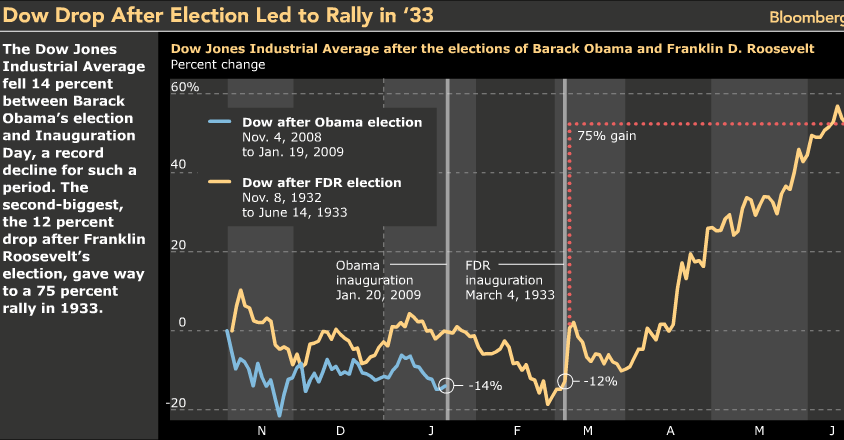
Here’s another meaningless Election/Politics/Market statistic/chart. I only link to it because it will likely be popular and one of your friends may buttonhole you and start yapping about it. The correct response: “It’s meaningless.”

It’s not that I hate Thomas Friedman — it’s hard to hate a person you haven’t even met in the flesh — it’s that I hate the fact that my otherwise-brilliant friends and family are snookered by such a pompous bag of wind. Matt Taibbi sums up my feelings on Friedman’s latest book.

I wrote a MoneyandMarkets.com piece about oil. In the short-term, I think it’s going lower. The longer-term forces are still there, but when will the next push higher begin? That’s the trillion-dollar question.

Labels:

Check out my new gold and energy blog at MoneyAndMarkets.com

Monday, August 25, 2008

Monday Charts on Gold, Oil & The Dollar -- and Plenty of News You Can Use

Analysts said this week -- with some U.S. markets closing early on Friday for the Labor Day holiday -- would likely be characterized by volatile prices and low trading volumes.
http://biz.yahoo.com/ap/080825/oil_prices.html

News of Interest

ECONOMY

U.S. and Global Economies Slipping in Unison

Only a few months ago, some economists still offered hope that robust expansion could continue in much of the world even as the United States slowed. Foreign investment was expected to keep replenishing American banks still bleeding from their disastrous bets on real estate and to provide money for companies looking to expand. Overseas demand for American goods and services was supposed to continue compensating for waning demand in the States. Now, high energy prices, financial systems crippled by fear, and the decline of trading partners have combined to choke growth in many major economies. The International Monetary Fund expects global growth to slow significantly through the end of this year, dipping to 4.1 percent from 5 percent in 2007.

How to stop the next bubble

"The financial crisis has shown that markets are bubble-prone and that laissez-faire regulation doesn’t work. The authorities need to get a grip if we are to avoid a mega-bubble. But we may need an even deeper crisis for that to happen."

BANKS

Columbian Bank and Trust Company, of Topeka, Kansas, is the latest bank to fail. Can things get worse? Heck, yeah! Check out the following chart from Calculated Risk …

From Calculated Risk: even with the failure of almost 3,000 banks and thrifts during the S&L crisis, the overall economy stayed fairly healthy with only a mild-to-moderate recession starting in July 1990.

Libor Signals Credit Seizing Up as Banks Balk at Lending in Money Markets Most of the bond strategists and salesmen that Resolution Investment Management Ltd.'s Stuart Thomson talked to last August expected the credit crunch to be long over by now. Instead, money markets show there's no end in sight, and it may even worsen.

CURRENCIES

Organized Crime Groups Dump Weak US Dollar For Euro

The weakened US dollar has fallen out of favor with organized crime groups to pay for drug shipments or to settle scores, a Canadian government report said Friday.

PAKISTAN -- THE NEXT CRISIS?

Pakistani Government On Brink Of Collapse

Pakistan's ruling coalition was at risk of collapsing Monday if its junior partner carries out a threat to quit unless judges ousted by ex-President Pervez Musharraf are restored immediately.

Taleban winning war (in Pakistan), says Zardari

The Pakistani Taleban have "the upper hand" and should be put on the list of banned organisations in Pakistan, Benazir Bhutto's widower has said.

CHINA

Olympics disappoint China business owners

Many owners of small restaurants, hotels and shops in Beijing are wearing long faces this summer, especially those who poured their life savings into buying businesses or sprucing up their shops ahead of the Games. About half a million foreign visitors were expected in Beijing this month. But many businesspeople think that because of stricter visa rules and other hassles, there are no more here now than there were last August, when 420,000 visitors from abroad came to the capital. In July, Air China, the nation's flagship carrier, saw its international passenger traffic fall by 19% from a year earlier.

China's Economic Gains Give Way to Hazy Future

In the next few years, China will cross the threshold to a majority-urban society. China's urbanization rate is about 40% to 45% now, well below levels of about 75% in most of Western Europe and Latin America, but statistics show that growth in China's urban population is already slowing.

China's 1.3 billion people each consumed the equivalent of 1.4 tons of oil in energy last year, a relatively low figure. If each Chinese was to consume the same amount of energy as each person in the U.S. does -- the equivalent of 7.82 tons of oil -- then China alone would consume nearly as much energy as the entire world does now.

So far, China's government is falling behind in its drive to cut the amount of energy required to produce each yuan of economic output. It managed a reduction of just 2.9% in the first half, less than last year's 3.7%

MINING & RESOURCES

Mining Industry Shifts on Bad News

Weaker commodity prices and higher costs are starting to take a toll on the global mining industry as the billions of dollars being spent on new projects could take years to recoup.

Demand for resources by China and other emerging markets still is expected to soar in the years ahead.

Some analysts view the recent mine closures as bullish for commodity prices in the long run, because the moves suggest companies are imposing more financial discipline than in past booms. As miners curb output, it could help prop up prices.

Still, the economics of mining have shifted drastically in recent years. The cost of energy to run mining trucks and other equipment has skyrocketed, while steel and other building materials also are more expensive.

Commodities Hint of Bottom as Mines Close, Crop Supplies at Five-Year Lows Corn and soybeans have rebounded as reduced crop yields push U.S. stockpiles to near five-year lows. Oil has reversed on U.S.-Russian tensions. Nickel has turned after Xstrata Plc closed a Dominican Republic plant.

Corn, Soybeans Jump as Midwest Crop Tour Forecasts Smaller U.S. Harvests Corn and soybeans gained after Professional Farmers of America said harvests in the U.S. will be smaller than forecast by the government as dry weather in August hurt Midwest crops already stunted by flooding in June.

Labels: , , , , , , ,

Check out my new gold and energy blog at MoneyAndMarkets.com

Monday, August 04, 2008

Monday Is Chart Day -- Storms, Oil, Gold & More

Tropical Storm Edouard Strengthens in Gulf of Mexico; May Become Hurricane Tropical Storm Edouard churned over the Gulf of Mexico and is forecast to approach hurricane strength on a course for Galveston, Texas, the biggest U.S. petroleum port. Parts of Louisiana and Texas were under a hurricane watch. XX Sean’s note – and yet oil is down a buck a barrel as I write this. That’s not a bullish sign.
The US dollar wins a beauty contest in a leper colony. It is going up because traders expect the ECB to cut rates if/when German employment falls.

XX Sean’s note – a platform for gold's next move up, or the start of gold’s next leg down?

OTHER NEWS

ENERGY

Kuwait Official Sees Oil Staying Above $100: Report

Oil is unlikely to fall below $100 per barrel as strong demand from emerging economies such as China and India put a floor under prices, a member of Kuwait's top oil council said in remarks published on Sunday.

Why Does Gas Cost $4 or More a Gallon?

That link leads to a great pictorial representation and explanation of rising gasoline prices.


SemGroup woes have ripple effect

Numerous Wichita-area and Kansas companies are on the 900-page list of creditors that SemGroup filed with U.S. Bankruptcy Court in Delaware. Company officials said it owes at least $2.52 billion just to its lenders.

"I think the greatest fear out there is that this is not an anomaly; that it might be the first of more to come," said Ed Cross, executive vice president of the Kansas Independent Oil and Gas Association.

ECONOMY

Fewest Treasury Traders Since 1960 Hit Taxpayers as Record Deficit Widens For the first time since 1960, when it created the network of securities firms obligated to buy and sell Treasury bonds, the U.S. government has the fewest bond traders making markets in its debt and a bigger burden for American taxpayers financing record federal deficits.

Rolling Recessions Bring Bernanke, King, Trichet Monetary Policy Paralysis Recessions are threatening to crash over the world economy in waves, as one country after another turns down a year after the onset of the global credit crisis.

BANKING

Automatic Earth Examines the Banking Crisis

There are 8,500 banks in the U.S. Based on an independent analysis by Chris Whalen from Institutional Risk Analytics, they have identified 8% of all banks, or around 700 banks as troubled. This is quite a divergence from the FDIC estimate. Should you believe a governmental agency that wants the public to remain in the dark to avoid bank runs, or an independent analysis based upon balance sheet analysis? The implications of 700 institutions failing are huge.

There is roughly $6.84 trillion in bank deposits. It is almost beyond belief that $2.6 trillion of these deposits are uninsured. There is only $274 billion of the $6.84 trillion as cash on hand at banks. This means that $6.5 trillion has been loaned to consumers, businesses, developers, etc. The FDIC has $53 billion to cover $6.84 trillion of deposits. Does that give you a warm feeling?

Housing Lenders Fear Bigger Wave of Loan Defaults

Homeowners with good credit are falling behind on their payments in growing numbers, just as the problems with subprime mortgages have begun to level off.

ENVIRONMENT

Gas costs, environmental worries lead more bike riders

Bicycling for reasons other than health and recreation is one way more and more people are responding to the arrival of gasoline prices that remain near $4 a gallon. The idea is to leave that car, truck or SUV in the garage more often.

The increase in bicycling is evident at area bike shops, which are having a hard time keeping pace with a surge in sales that operators think is fueled by higher gas prices. Stripped of 2008 inventories, some well-known bicycle brand names are rolling out their 2009 models several months earlier than usual, said Bernie Camp, sales manager at Russell’s Cycling in Washington.


Death in the Gulf of Mexico

Every year for the past couple of decades, scientists have tried to estimate the size of the dead zone that forms where the Mississippi River enters the Gulf of Mexico. Some years it is several times as large as Lake Pontchartrain. Last year it was the size of New Jersey. This year, it may well be as large as Massachusetts, possibly even exceeding the size it was in 2002 — nearly 8,500 square miles where almost nothing lives.

Labels: , ,

Check out my new gold and energy blog at MoneyAndMarkets.com

Tuesday, July 22, 2008

Great News for Red-Hot Global Stocks

Check out the news on Kingsgate and Sino Gold, two recent additions (albeit repeat buys) to the Red-Hot Global Small-Caps portfolio …

Kingsgate Jumps Most in 10 Years After Winning Approval for Thailand Mine Kingsgate Consolidated Ltd., owner of Thailand's biggest gold mine, rose by the most in a decade in Sydney trading after receiving final ministerial approval for the Chatree North mining lease next to its existing operation.

Sino Gold 2nd-Quarter Output From Jinfeng Mine Rises More Than Threefold Sino Gold Mining Ltd., owner of China's second-largest gold mine, said second-quarter output at the Jinfeng operation rose more than threefold as a greater volume of ore was mined.

And here's my latest interview with Phil at HoweStreet.com ...

http://tinyurl.com/6cc7qb

In Other News …

Just how much money does China have? How fast are China’s foreign assets growing? And how much is hot money?

XX Sean’s note – this post at Brad Setzer’s blog is well worth reading. The numbers on China may shock you. And the charts, well …

ECONOMY

The global economy is at the point of maximum danger

It feels like the summer of 1931. The world's two biggest financial institutions have had a heart attack. The global currency system is breaking down. The policy doctrines that got us into this mess are bankrupt. No world leader seems able to discern the problem, let alone forge a solution.

The International Monetary Fund has abdicated into schizophrenia. It has upgraded its 2008 world forecast from 3.7pc to 4.1pc growth, whilst warning of a "chance of a global recession". Plainly, the IMF cannot or will not offer any useful insights.

Its "mean-reversion" model misses the entire point of this crisis, which is that central banks have pushed debt to fatal levels by holding interest too low for a generation, and now the chickens have come home to roost. True "mean-reversion" would imply debt deflation on such a scale that would, if abrupt, threaten democracy.

FANNIE MAE-FREDDIE MAC MELTDOWN WATCH

Pimco's Gross Says Fannie, Freddie Need Treasury

Bill Gross, who manages the world's biggest bond fund, said it's not possible for government sponsored mortgage-finance companies Fannie Mae and Freddie Mac to raise capital without the Treasury Department's support.

``Let's be blunt: to the extent the Treasury suggests they'll never have to use their authority, that's a sham,'' said Gross of Pacific Investment Management Co. ``It's fallacious to suggest that the agencies could issue capital, preferred stock, without the co-participation of the Treasury. I don't think that's possible.''

Fannie, Freddie May Record More Losses on Subprime, Alt-A Debt, Ofheo Says Fannie Mae and Freddie Mac may need to record more writedowns after they expanded their purchases of non-guaranteed subprime and Alt-A mortgage securities just as other investors fled to safer investments, their regulator said

Measures to avoid the worst recession in 30 years

Ben Bernanke, Federal Reserve chairman, this week alluded to an economy facing “numerous difficulties”. In fact there are only two, but each alone is cause for genuine concern over the US economy’s prospects: first, an implosion of the financial system triggered by the teetering housing market; and, second, record prices for oil and other commodities that are largely driven by events abroad. … It is time to devise a programme to promote overall economic recovery by fighting for the economy’s future on both fronts simultaneously.

ENERGY

Goldman Sachs Group Says Energy Stocks Are a `Buy' After Shares Retreated Investors should buy energy stocks, which fell the most last week in six months, as oil prices will rebound, Goldman Sachs Group Inc. said.

OPEC Must Increase Oil Output to Lower Prices, Promote Growth, CGES Says OPEC needs to raise oil production to reduce crude prices and help global economic growth, the Centre for Global Energy Studies said.

IEA warns non-Opec oil could peak in two years

Oil production in non-Opec countries is set to peak within the next two years, leaving the world increasingly dependent on supplies from the cartel of exporting nations, according to one of the world's leading energy experts.

Fatih Birol, chief economist of the International Energy Agency (IEA), said that falling production from key regions such as the North Sea and the Gulf of Mexico would leave international oil companies such as Shell and BP increasingly sidelined at the expense of national oil companies, such as Saudi Aramco.

URANIUM

Kazakhstan Wants to Be World's Biggerst Uranium Miner in 2009, Top Canada Kazakhstan, the world's third- biggest uranium miner, plans to overtake Canada and Australia next year by producing 12,826 metric tons of the radioactive metal.

Xx Sean’s note – sure beats the other leading occupation in Kazakhstan … turd farming.

Labels: , , , , ,

Check out my new gold and energy blog at MoneyAndMarkets.com

Thursday, July 17, 2008

The Government Changes The Rules in The Middle of The Game

This is why I hate government most of the time.

According to Reuters, The U.S. Securities and Exchange Commission issued an emergency order on Tuesday placing restrictions on the short selling of shares of certain major financial firms.

Here are 19 stocks where no naked short selling is allowed from July 21 through July 29 (though they may extend it to 30 days):

* BNP Paribas Securities Corp
* Bank of America Corp
* Barclays PLC
* Citigroup Inc
* Credit Suisse Group
* Daiwa Securities Group Inc
* Deutsche Bank Group AG
* Allianz SE
* Goldman Sachs Group Inc
* Royal Bank ADS
* HSBC Holdings Plc ADS
* JPMorgan Chase & Co
* Lehman Brothers Holdings Inc
* Merrill Lynch & Co Inc
* Mizuho Financial Group Inc
* Morgan Stanley
* UBS AG
* Freddie Mac
* Fannie Mae

Gee, I thought JP Morgan had blow-out earnings today … but apparently they’re so weak you can’t short-sell them. And yet Washington Mutual, which is swirling in a sea of failure rumors, is not on the list. I have no position on whether those rumors are true or false – it’s just that that if any stock is going to need protection from speculators, it’s WM. So is the government protecting weak stocks … or is it something else?

Have you ever seen anything so cockamamie? Either allow short-selling for all stocks or don’t, but picking out 19 stocks for special treatment is ludicrous. And while I appreciate they are trying to give the market time to find its footing, changing the rules like this could backfire and just put off the day of reckoning, making it worse. Let’s see what happens after July 29 (or after August 20 if they extend it)

As has been pointed out elsewhere, China had short sale restrictions on and it did not stop the Shanghai index from falling over 50%. Insolvency cannot be cured by short sale restrictions and some or even many of those companies may be insolvent.

The SEC’s list of 19, of course, is heroin for conspiracy junkies. But what if the conspiracy theorists are right? Check out this comment I picked up from Mish Shedlock’s blog, where savvyinvestor writes…

I would like you all to consider a market manipulation scenario which is becoming increasingly credible when you consider the moves in equities and commodities over the past 2-3 days. Let us suppose that Paulson went to his buddies at Goldman Sachs and worked out a deal: "We will give you the regulatory framework you need to make a killing; in turn, you bail out the financials."

So here's how it works. "Naked short selling" will not be allowed starting monday - why not today? Because they need several days to get the mother of all pump-n-dumps in place. To raise money, GS first dumps all its commodities longs. It dives into the targeted financials and begins accumulating massive numbers of shares.

Come Monday, you can short the stocks if you like - but you have to borrow the share first. And where are you going to borrow the share if Goldman Sachs' hedge funds have a lion’s share of the float? With no possibility of short selling, and a huge number of shares tied up so that buyers are competing for a much smaller share pool, the financials' shares skyrocket, getting back the last years' losses in a couple of weeks. Then GS dumps its shares, for profits in the hundreds of billions, Fannie raises its capital, and the crisis has been averted without spending a single taxpayer dime - but at the cost of swindling millions of investors who don't have the inside knowledge of how this scam is being worked or what the timing is.

XX Sean’s note -- That theory may not be correct, but it sure is interesting. Meanwhile …

As faith in bank bailouts dims, losses set to deepen

The nightmare scenario for U.S. economic authorities is here: confidence in their ability to rescue the country from a housing-led financial panic is now at its lowest level since the crisis began.

XX Sean’s note – and what about the U.S. dollar? Well, there are some pretty interesting developments there, too. The Financial Times reports that …

Sovereign funds cut exposure to weak dollar

Some of the world’s largest sovereign wealth funds are seeking to scale back their exposure to the US dollar in a sign of global concern about the currency.

One big sovereign fund in the Gulf has cut its dollar-denominated holdings from more than 80 per cent a year ago to less than 60 per cent, while China’s State Administration of Foreign Exchange (SAFE) has been looking to strike deals with private equity firms in Europe as a part of a strategy to reduce its dollar holdings.

In Other News

ENERGY

Oil Falls for Third Day as Slower Global Economic Growth Curbs Fuel Demand Crude oil fell for third day, the longest losing streak for a month, on speculation slower global economic growth is curbing fuel consumption.

Xx Sean’s note – still, the support I talked about yesterday seems to be holding, so far anyway.

Summary of Weekly Petroleum Data for the Week Ending July 11, 2008

U.S. commercial crude oil inventories (excluding those in the Strategic Petroleum Reserve) increased by 3.0 million barrels from the previous week. At 296.9 million barrels, U.S. crude oil inventories are near the lower boundary of the average range for this time of year. Total motor gasoline inventories increased by 2.4 million barrels last week, and are in the upper half of the average range. Both finished gasoline inventories and gasoline blending components inventories increased last week. Distillate fuel inventories increased by 3.2 million barrels, and are in the upper half of the average range for this time of year. Propane/propylene inventories increased by 1.0 million barrels last week but remain below the lower limit of the average range. Total commercial petroleum inventories increased by 7.5 million barrels last week, and are near the bottom of the average range for this time of year.

XX Sean’s note – so, higher prices at the pump are definitely having a deeper effect on consumption. Top of Form

And here's what they were expecting: Analysts surveyed by Platts expect that U.S. crude stockpiles decreased by 3 million barrels last week. They also expect a decline of 1.1 million barrels in gasoline inventories and a buildup of 1.7 million barrels in distillates.

Crude Awakening

If this document is accurate, it means that Simmons was right on the money. What's worse, the details are even more discouraging: as the chart on the right shows, what little production increase the Saudis can sustain is all in medium and heavy crudes. Production of light crude, preferred by most refineries, actually decreases by 200,000 barrels per day between now and 2013.

CLIMATE CHANGE

Ice shelf near collapse

Scientists are warning that an Antarctic ice shelf the size of Northern Ireland is on the verge of disintegration, even though it is the middle of winter. The shelf, near the base of the Antarctic Peninsula, had not been expected to collapse until the early 2020s.

Xx -- Sean's note: In other news, the outlook for storms in the tropics (hurricane weather) is weakening. It looks like we can rest a little for the next few days after an extremely active July 16th......the Florida disturbance dissipated, 94L's window of opportunity may have closed, and the SW Caribbean area will go inland. Hooray for us!

CHINA

China's Economic Growth Cools to 10.1%, Adding Pressure to Slow Yuan Gains

China's economy grew at the slowest pace since 2005 in the second quarter, prompting speculation the government will slow the yuan's gains to protect export jobs.

China's First-Half Vehicle Sales Growth Slows to 19%

XX Sean’s note – US car makers would kill for 19% growth. And this is an interesting line in the news item: “vehicles are becoming affordable to more people in China because of the country's 10 percent economic growth rate and price cuts triggered by rising competition. The proportion of people owning vehicles in China is also only equal to that seen in the U.S. in 1925 and in the U.K. in 1950.”

Private cars to be on Beijing streets on alternate days

Car owners in Beijing will have to remember the last digit of their licence plates and the day of the week before taking their vehicles out on the streets from Sunday as traffic management gets into top gear for the Olympics next month. According to an odd-even number traffic control plan devised by the local authorities, private vehicles will be allowed on the streets on alternate days. If a car with an odd numbered licence plate is allowed to ply Sunday, those with even numbers will get the opportunity the next day.

XX Sean’s note – this may weigh on global oil demand and prices going forward. I thought Beijing would wait until the games started to begin their “license plate bingo” but apparently they’re starting early. They’ve closed down over 100 polluting factories, too.

CANADA

May Factory Sales Gain More Than Five Times Forecast on Energy, Metals Canadian factory shipments rose 2.7 percent in May, the biggest one-month gain since March 2007 and more than five times as much as anticipated, as sales of petroleum and coal products surged.

US ECONOMY

U.S. Consumer Prices Climb Most Since 1991; Homebuilder Confidence Slumps

U.S. consumer prices surged 5 percent in the past year, the biggest jump since 1991, just as households struggled with falling home values and the credit crunch. Spiraling expenses for food and fuel spurred the increase in June, the Labor Department said today in Washington. The cost of living rose 1.1 percent from May, more than forecast and the second-largest rise since 1982.

`Misery Index' in U.S. Advances to 15-Year High as Inflation Accelerates

Misery hasn't had this much company in more than 15 years. The jump in consumer prices reported today by the Labor Department means the so-called Misery Index, the sum of the unemployment and inflation rates, is the highest since President Bill Clinton took office in January 1993. The measure, created by Arthur Okun, an economics adviser to President Lyndon Johnson, rose to 10.5 in June from 9.7 in the prior month.

Labels: , , , , ,

Check out my new gold and energy blog at MoneyAndMarkets.com

Wednesday, July 16, 2008

The Devil Is In The Details

Oh, Dang! I put a MoneyandMarkets.com column (Consider Gold & Silver Now!) to bed and it is already overtaken by events.

First this …

Global Economic Decline Appears to Be Spreading (WSJ – subscription required).

The rising risk of recession in Europe shows that despite the strength of emerging-market economies such as Russia and China, the economic downturn that began in the U.S. last year is spreading to other regions, battering hopes that the global economy might have "decoupled" just enough that the rest of the world could coast through a U.S. downturn relatively unscathed.

Sean’s view -- So why is the US dollar going down in relation to the euro and the yen today? Because we’ve got lines snaking around the block at troubled banks as customers line up to take their money out. Now that will put the fear of God into currency traders.

If you click through on that Wall Street Journal story, you’ll see they talk about emerging market economies (Russia, China, India) still going strong even as the rest of the world slows down – just as I talked about in my MoneyandMarkets.com column.

However, this next piece of news works against what I wrote in the column …

US official to attend meeting with Iran's nuclear negotiator

A senior US diplomat will attend international nuclear talks with Iran on Saturday, marking a shift in US policy on negotiations with Tehran, a State Department official said.

Sean’s view -- If the US and Iran are talking, there is less chance of a new war in the Middle East. Still, I think the basic points of my column today are valid. I’m nervous as hell, and you should be, too.

Finally, let’s talk about yesterday’s big pullback in oil, triggered by economic fears and rumors that a big bank was selling its oil positions to cover other losses. The pullback seems likely to continue today, as tensions ease in the Middle East. Did you see how oil found support yesterday around $136? In fact, there is strong support for oil between $133.25 and $136.25. Oil will have to break below that range for me to start thinking we’ll see a good pullback.

And what would a pullback mean? $125 … $120 … or maybe a drop to that strong support line at $110? Oil would still be over $100 a barrel … making the oil and gas companies I recommend some of the most profitable companies on Earth.

And this chart shows the real story ...

Source: http://netoilexports.blogspot.com/

Exports are flat to trending down, even as demand in the emerging markets goes up. That math leads to higher prices, even if it is a bumpy, sometimes confusing ride.

Now to answer a reader question:

Q -- I keep hearing that the speculators are not to blame – that they can’t affect the spot price. So why does the oil spot price fall big time when the futures are cashed in?

A -- No one has said that futures can't affect the spot price of crude. They very much affect the spot price. But that does not mean that speculators are to blame for the high price of oil.

Speculators affect the short term swings in the price of oil but the general trend is affected by supply and demand. When speculators bid the price too high, the fundamentals eventually pull the price back into line and the speculators that were long get burned. The opposite happens when speculators short oil and drive it down below the fair price. The shorts get burned when supply and demand pulls the price back in line. This is why it’s important not to get too wrapped up in the short-term swings in the price of crude – the longer-term trend is much more important.

In other news …

The $1.4 Trillion Question

Through the quarter-century in which China has been opening to world trade, Chinese leaders have deliberately held down living standards for their own people and propped them up in the United States. This is the real meaning of the vast trade surplus—$1.4 trillion and counting, going up by about $1 billion per day—that the Chinese government has mostly parked in U.S. Treasury notes. In effect, every person in the (rich) United States has over the past 10 years or so borrowed about $4,000 from someone in the (poor) People’s Republic of China. Like so many imbalances in economics, this one can’t go on indefinitely, and therefore won’t. But the way it ends—suddenly versus gradually, for predictable reasons versus during a panic—will make an enormous difference to the U.S. and Chinese economies over the next few years, to say nothing of bystanders in Europe and elsewhere.

Senator asks if nation's drivers should slow down

An influential Republican senator suggested Thursday that Congress might want to consider reimposing a national speed limit to save gasoline and possibly ease fuel prices.

Sen. John Warner, R-Va., asked Energy Secretary Samuel Bodman to look into what speed limit would provide optimum gasoline efficiency given current technology. He said he wants to know if the administration might support efforts in Congress to require a lower speed limit.

Where Americans will (and won't) cut back

Many Americans are leaving the car in the garage and staying on their living room couch. A whopping 50% of Americans plan to buy an HD or flat-panel TV in the next year, the study showed, with little difference between those who are hardest hit by the downturn and those who are not. Cable and satellite TV subscriptions are also way down the list on cutbacks.

Despite the expense, another thing consumers refuse to give up altogether is vacationing and travel. Even in these tough times, 59% of Americans plan to take a trip of 100 or more miles in the next six months - only slightly below the 61% average of recent years.

Downturn gains steam as inflation roars ahead

The Labor Department said wholesale inflation, driven by skyrocketing gas and food costs, rose by 9.2 percent for the 12 months ending in June -- the fastest pace since the summer of 1981, during another energy crunch.

China June auto sales up 15.35% yr-on-yr at 836,800 units

Automobile sales in China rose 15.35 pct year-on-year in June to 836,800 units, with output up 13.96 pct at 837,200 units, the China Association of Automobile Manufacturers said. The association said in a statement that passenger vehicle sales rose 4.2 pct last month from a year earlier to 588,400 units, while commercial vehicle sales were up 15.58 pct at 248,400 units. In the first half, total auto sales grew 18.52 pct from a year earlier to 5.18 units with passenger vehicle sales up 17.07 pct at 3.61 mln and sales of commercial vehicles increasing 21.98 pct to 1.57 mln units.

Labels: , , ,

Check out my new gold and energy blog at MoneyAndMarkets.com

Tuesday, July 15, 2008

News You Can Use for Tuesday

There's a lot to cover today, so let's get busy ...

ECONOMY

Housing, banking crisis piles pressure on Bush

The housing crisis in the United States is fast spilling into a banking and financial debacle that could destabilize the world economy and put mounting pressure on the Bush administration to act.

Recession-Plagued Nation Demands New Bubble To Invest In

(Satire from The Onion) A panel of top business leaders testified before Congress about the worsening recession Monday, demanding the government provide Americans with a new irresponsible and largely illusory economic bubble in which to invest.

"What America needs right now is not more talk and long-term strategy, but a concrete way to create more imaginary wealth in the very immediate future," said Thomas Jenkins, CFO of the Boston-area Jenkins Financial Group, a bubble-based investment firm. "We are in a crisis, and that crisis demands an unviable short-term solution."

OIL

How Cuba Survived Peak Oil

Xx Sean’s note -- Ignore the fact that the author is glossing over all the bad stuff you know about the Cuban government. This is a story about how a country survives when it loses more than 50 percent of its oil imports, much of its food and 85 percent of its trade economy. In other words, this may have lessons for America in the future.

12mn barrels per day is Saudi Arabia's oil limit

Saudi Arabia won't be able to pump more than 12 million barrels per day (bpd) by 2010, and its sustainable production level will be only 10.4 million bpd, it was reported on Monday. BusinessWeek magazine cited a field-by-field breakdown of output it obtained from an oil industry executive.

Petrobras Union Rejects Settlement Offer, to Continue Campos Basin Strike Brazil's oil-workers union in the Campos Basin, the source of more than 80 percent of the country's oil, rejected a settlement offer from their employer, state-controlled Petroleo Brasileiro SA.

Oil Rises Above $146 as Dollar's Drop to Record Low Boosts Crude's Appeal Crude oil rose above $146 a barrel as the dollar fell to a record low against the euro, boosting the appeal of commodities as a currency hedge for investors.

Bush lifts offshore drilling ban in symbolic move

President George W. Bush lifted a White House ban on offshore drilling on Monday to try to drive down soaring energy prices, a largely symbolic move unlikely to have any short-term impact on high gasoline costs.

URANIUM

Uranium Advances 5.4% as Demand Jumps to Almost Double Supply

Uranium-oxide concentrate for immediate delivery climbed to $63.25 a pound, $3.25 more than a week before, TradeTech said in a July 11 report. There were eight sales totaling more than 1.2 million pounds last week, it said. Demand grew by a third to about 4.2 million pounds of uranium oxide, while supply held at 2.4 million.

Brown sets 'no limit' on number of reactors to be built

Gordon Brown is to fast-track the building of at least eight nuclear power stations to cut Britain's dependence on oil following the dramatic rise in its price. The Prime Minister will set "no upper limit" on the number of nuclear plants that will be built by private companies. That would mean nuclear, which provides about 20 per cent of Britain's electricity, could meet a bigger share after the new generation of nuclear stations come on stream over the next 15 years.

Contaminated US site faces 'catastrophic' nuclear leak

More than 210 million liters of radioactive and chemical waste are stored in 177 underground tanks at Hanford in Washington State. Most are over 50 years old. Already 67 of the tanks have failed, leaking almost 4 million liters of waste into the ground. There are now "serious questions about the tanks' long-term viability," says a Government Accountability Office report, which strongly criticizes the US Department of Energy for delaying an $8 billion program to empty the tanks and treat the waste. The DoE says the clean-up is "technically challenging" and argues that it is making progress in such a way as to protect human health and the environment.

Xx Sean’s note – I wrote about Hanford in my original “Golden Age of Uranium” report. It’s a problem we MUST tackle IMMEDIATELY – otherwise, we risk a catastrophic nuclear leak that would not only be an environmental disaster, it would turn the American people against nuclear power and turn out the lights on any future nuclear development.

CHINA

China Growth Probably Cooled to 10.3% in Second Quarter as Exports Slowed China's economic expansion probably slowed for a fourth straight quarter as exports cooled, raising the possibility that the government will switch focus to sustaining growth from fighting inflation.

GOLD

Barrick Gold Offers to Buy Cadence in Hostile Takeover for $348 Million Barrick Gold Corp., the world's largest gold producer, offered to buy oil and natural gas explorer Cadence Energy Ltd. for about C$349.9 million ($347.9 million) as it seeks to deal with surging energy costs.

Gold Rises to Highest in Almost Four Months in London on Flight-to-Safety Gold rose for a fifth day in London, trading close to a four-month high, as tension in the Middle East and financial concerns in the U.S. increased investor demand for the metal as a haven.

Labels: , , , , ,

Check out my new gold and energy blog at MoneyAndMarkets.com

Monday, July 14, 2008

News You Can Use for Monday -- Bank Failure Extravaganza

Today, the big news that could move commodities is not in China or the Middle East -- it's right here at home. US banks are failing and the Federal Government is going to bail out Fannie Mae and Freddie Mac. I think this has big implications for the US dollar, and not in a good way. I'll be writing more about this in Wednesday's Money and Markets. For now, here is some news of interest ...

Fannie, Freddie Too Critical to Fail, Lawmakers Say
A government takeover of one or both companies is among several options that have been considered by White House officials, according to a person familiar with the discussions who spoke on condition of anonymity. Senior Bush administration officials are considering placing either or both firms in a conservatorship if their problems get worse, the person said.

Paulson Puts Treasury Behind Fannie Mae, Freddie Mac in Bid to Calm Market
Paulson, speaking on the steps of the Treasury facing the White House, asked Congress for authority to buy unlimited stakes in and lend to the companies, aiming to stem a collapse in confidence. The Federal Reserve separately authorized the firms to borrow directly from the central bank. Fannie and Freddie shares surged in Frankfurt trading.

After IndyMac, Who's Next?
Thornberg says, “We’re still early in this cycle.” He says regional banks don’t suffer the bulk of their problems until late in a credit downturn. We can expect to see home loan delinquencies to continue to spread to personal loans, car loans and student loans. He also says the next big shoe to drop is regional banks with a lot of exposure to builders, including commercial builders who are building condos or other projects that will fail.

Oil Brings Americans Closer to OPEC Debtor Dependence Supplanting Japanese

Holdings of Treasuries by oil producers and institutions such as U.K. banks that are proxies for Middle East nations rose 44 percent this year to $510.8 billion through April, four times faster than the rest of the world, according to the Treasury Department's most recent data. At the current pace, they'll surpass Japan, which holds $592.2 billion, as the largest owner this month.


Sean's Special Comment ...

Jerry Bowyer is a right-wing hack. As long as Mr. Bowyer is blaming Sen. Schumer for causing IndyMac's failure -- a blatant impossibility -- let's call Mr. Bowyer what he is: A right-wing hack who would blame Democrats for a rainy day.

Both parties, Republican and Democrat, are culpable for the crisis in our financial system, but it's not due to what Bowyer and other hack-ologists are blaming Schumer, who pointed out IndyMac's shortcomings. It's the way Congress covered for and enabled the "Casino Mentality" in the financial sector, where banks made bad loans and pawned them off on investors with reckless abandon, not worried if any of those particular loans came up snake eyes.

If you gamble recklessly and continually, eventually, you'll lose.

Now, A
merica is going to foot the bill for Wall Street's losing streak. Here's an idea: Let's go after the pay packages over the last 10 years of all the top executives and board members of banks and lenders that fueled this insane mortgage mess. That might be a lesson that Wall Street will remember the next time it decides to head to the Big Casino with your money.

And there will probably be a lot of money to collect. More than 300 banks could fail in the next three years, said RBC Capital Markets analyst Gerard Cassidy, who had in February estimated no more than 150.

That said, I don't think garnishing the wages of Wall Street bankers is a solution that Washington will actually pursue (it's too logical). But when the house is on fire, it's time to find workable solutions -- and quickly -- and not waste time trying to place blame on those who raised the alarm.

Labels:

Check out my new gold and energy blog at MoneyAndMarkets.com

Sunday, July 13, 2008

Are You Ready for the Credit Card Crisis?

Some fascinating facts in this must-read story by Danny Schecter in LACityBeat ...

How bad is it?

• Financial analysts say that in the U.S. alone more than $850 billion in unpaid credit card balances is at stake and fast approaching $1 trillion, roughly the same amount as in the subprime market.

• CNN reports that worldwide, consumers have racked up more than $2.2 trillion in purchases and cash advances on major credit cards in just the last year.

• The unpaid debt portion of this is continuing to pile up, with U.S. consumers last year adding $68 billion against their credit lines, boosting credit card debt by 7.8 percent, the largest increase in seven years, just when the last recession was beginning.

• Even as they spent, consumers have been going into default at a stunning rate. The percentage of people delinquent on their credit cards is soaring, and credit card companies are now writing off somewhere near 5 percent of payments.

• By last fall, the major banks were setting aside billions for loan-loss reserves while anticipating an increase of 20 percent in non-payments over the next two to four quarters.

• Capital One, one of the biggest credit card banks, was forced to write off $1.9 billion in bad debt just in the last quarter of 2007.

•By October, according to a survey of only the leading credit card banks by the Associated Press, the value of credit card accounts at least 30 days late was up 26% from the previous year, to $17.3 billion. Serious delinquencies among some of the biggest lenders rose by 50 percent or more in the value of accounts that were at least 90 days delinquent.

• Making matters worse, or more widespread throughout the economy, just as with mortgage debt, credit card debt is put into pools that are then resold to investment houses, other banks and institutional investors. About 45 percent of the nation’s $900-plus billion in credit card debt has been packaged into these pools, and so many companies, not just a few, are at risk of being forced out of business by credit card debt write-offs.

Schecter goes on to write ...

Since Ronald Reagan, we have been living in an era in which neither the meltdown of the savings and loan banks in the 1980s nor the Enron-like scandals of the Bush years has stopped the relentless advancement and protection by both parties of the ability of financial institutions to make a buck at any cost to the social good and economic fabric. Which is what you get, of course, when both parties are so dependent on massive financial contributions to get their candidates into office and when the corporate media, heavy with advertising from the FIRE sector – Finance, Insurance and Real Estate – doesn’t warn the public or investigate the egregious fudging, misrepresentation and outright fraud that underpins the subprime and looming credit card crisis.

Labels:

Check out my new gold and energy blog at MoneyAndMarkets.com

Saturday, July 12, 2008

Recession in a Time of $147 Oil and a Blastoff in Gold!


And now, here's some "must-read" news for the weekend ...

Government shuts down mortgage lender IndyMac

The bank is the largest regulated thrift to fail and the second largest financial institution to close in U.S. history, regulators said.

Some 10,000 depositors had funds in excess of the insured limit, for a total of $1 billion in potentially uninsured funds, the FDIC said.

Trade Gap Unexpectedly Shrinks

The trade deficit shrank unexpectedly in May as the U.S. bought less oil and exports increased. The news prompted a bit more optimism in the outlook for economic growth for this year, but separate reports showed that consumers remain gloomy and import prices continue to soar.

The gap between the value of the country's imports and exports narrowed 1.2% to $59.79 billion from $60.50 billion in April, the Commerce Department said, as petroleum imports fell by 10.5%. The data signaled that strength in America's export market, reinforced by the weak dollar, is helping prop up an otherwise sagging economy.

XX Sean’s note – If our exports are INCREASING, other countries (I’ll spot you a “C”) are NOT experiencing a recession. Want some evidence? Here …

IEA Raises 2008 World Oil Demand Forecast by 80,000 bpd

The International Energy Agency raised its forecast for world demand for oil for 2008 for the first time in several months, and anticipates demand in 2009 to increase by 1.1 percent to 87.7 million barrels per day, driven by emerging countries. The IEA, which had cut its forecast for world demand for 2008 for five months running, in its June report raised its forecast for the 2008 demand to 86.9 million barrels per day, an increase of around 80,000 bpd. World demand is therefore seen increasing by 890,000 bpd this year.

Also HERE (subscription required)

In other news …

Oil Stocks Hit Bargain Bin

The stock price of major oil companies hasn't kept pace with the price of a barrel of oil, which is now 95% more expensive than 12 months ago. Investors are skeptical that majors such as Exxon Mobil Corp. and Royal Dutch Shell PLC, which do everything from drilling oil to refining it to selling it, are going to have big futures. The stocks are actually down this year.

investors are skeptical that oil can stay at current levels: Prices may not fall below $100 a barrel but won't stay above $140, the consensus runs. That belief has led to the discounting in major oil stocks. Exxon's earnings per share have gone up 380% from 2003 until the end of June, but the stock price is up only 150% during this period. The P/E has come down, from about the low 20s to 11 more recently.

Au Revoir or Goodbye?(subscription required)

PHIL GRAMM, THE FORMER SENATOR FROM TEXAS, doesn't know beans about the economy, and he has a Ph.D. in economics to prove it. Last week, in an interview with a D.C. paper, he pronounced the United States a "nation of whiners" wringing their hands and moaning like mad about a recession that's all in their pointy little heads (those last three aren't exactly his words, but they sure do capture his meaning).

Mr. Gramm is now not only an ex-senator but also, thanks to his public whining about whiners, an ex-adviser to John McCain, as the presumptive GOP nominee for the presidency revs up to go mano a mano with Backtrack Barack. Gramm also happens to be dead wrong on the state of the economy. Just ask any working person striving to cope with the twin terrors of runaway prices and standstill wages

If the continuing demolition of the housing industry that has already wrought half a million foreclosures and threatens to add several million more to the woeful total; the vicious credit crunch; the humongous bite of $140-plus-a-barrel crude and $4.50-a-gallon gasoline; the remorselessly rising cost of such existential items as food, medical care and education; 5.5% unemployment even by Uncle Sam's skewed reckoning; rock-bottom consumer confidence; and the trillions that went up in smoke in global stock values in the first half of this year are all figments of our febrile imaginations, we'd just as soon not hear what kind of economic hell would qualify in Gramm & Co.'s eyes as a recession.

But then, it's always possible, we suppose, recession simply isn't allowed in the cosseted environs of Washington and the more rarified reaches of Wall Street.

Labels: , ,

Check out my new gold and energy blog at MoneyAndMarkets.com

Monday, July 07, 2008

Monday Charts and News -- Breakthrough Oil Technology and More

Buyers of my new oil report will remember Repsol. Here's some good news ...

Repsol Chases Breakthrough Technology as Offshore Oil Politics Heat Up

Spanish-Argentinean oil major Repsol and the Barcelona Supercomputing Center’s Kaleidoscope Project team at the World Petroleum Congress in Madrid on July 1 announced early research results that lead them to believe a major breakthrough in offshore oil exploration is within reach. Working with IBM BladeCenter QS22 supercomputers -- built around IBM’s PowerXCell 8i processor, originally developed for use in Sony video game consoles -- Repsol and BSC researchers believe they now have a methodology, "Reverse Time Migration", and the tools to speed up exploration and development of deep oil and gas fields on- and off-shore up to six times compared to the technology currently employed by the oil and gas industry.


Here are some charts ...


Up, up and away!

From Calculated Risk

Using the EIA price data, and making a few assumptions (no increase in energy consumption in 2008, and an energy mix of 40% petroleum, 23% coal, 23% natural gas, and 14% nuclear and renewables), we can estimate that energy consumption as a percent of U.S. GDP will set a record in 2008 of over 14%.

Banking Losses to Hit $1.6 Trillion

From Infectious Greed ….

The expected losses from the financial crisis will reach $1600 billion. To-date financial institutions have so far announced only $400 billion. The pessimistic forecast comes from a confidential study by Bridgewater Associates, the second largest hedge fund in the world.

"We are facing an avalanche of bad assets," says the study. The biggest losses were the U.S. credit banks before. "We have big doubts that the financial institutions will be able to have enough new capital in order to cover the losses," the authors write.

Vroom-Vroom!

From Bloomberg …

Mattel's market cap just surpassed that of GM. The maker of Hot Wheels and Matchbox now has a market cap of $6.22B versus the $5.76b cap of the maker of non-toy cars GM.

Oil Trades Near $144 After Falling on Iran's Response on Nuclear Program Crude oil traded near $144 a barrel in New York as Iran said its nuclear program policy remains unchanged a day after responding to an incentives package by world powers to halt uranium enrichment.

XX Sean’s note – 5 gets you 10 that this good news on Iran falls apart in the next couple weeks.

Corn, Soybeans May Rise as Hot Weather Threatens U.S. Crop, Survey Shows Corn and soybeans may rise to records on speculation a shift to hot, dry weather will reduce plant yields after record rains last month in the U.S. Midwest stunted root development, leaving crops vulnerable to heat stress.

Cameco Scoops 550t of Yellowcake in Secret Deal

Saskatoon-based Cameco Corp. purchased the reported 550 tonnes of ''yellowcake'', the seed material for higher-grade nuclear enrichment, in a deal reported to be in the tens of millions of dollars.


Labels: , , , ,

Check out my new gold and energy blog at MoneyAndMarkets.com