Red-Hot Resources

"Luck is not chance, it’s toil; fortune’s expensive smile is earned.”

Sunday, June 08, 2008

Sunday Reading List -- My Analysis of Current Events

G-8 to fight oil prices with efficiency, tech

XX Sean's note -- rolling back the speed limits and strict, enforced conservation measures never enter the conversation. We are so doomed if we are led by these babbling idiots for much longer.

Also adding to the problem ...

Some 86 billion barrels of oil and 420 trillion cubic feet of natural gas are beneath America's waters, DOI says. Of those amounts, 19.1 billion barrels of oil and 83.9 trillion cubic feet of gas lie in federally-controlled territorial waters that are completely off-limits to leasing and development.

But don't worry. OPEC says there's plenty of oil on the market.

In other news ...

West Australian Miners Brace for Productivity Drop
Western Australian miners, which supply the world with metals and iron ore, fear sharp falls in productivity and lay-offs after a gas-plant explosion robbed them of power, industry and local government officials said on Sunday.
Western Australia lost about a third of its energy supplies last week when an explosion crippled a gas-handling plant on the tiny island of Varanus, about 100 km (62 miles) off Australia's northwest coast. The Varanus plant, close to offshore gas fields, is operated by a unit of U.S.-based Apache Corp.
Tim Wall, managing director of Apache's Australian unit, said on Sunday he was sticking with an earlier estimate of "months, not weeks" before damage to the plant and associated gas pipelines was repaired and operations could restart.

XX Sean's note -- Western Australia supplies about a third of the world's iron ore, 20% of its gold and copper, zinc and nickel as well. This is very bullish news for the short-term price outlook in these commodities.

ESPN Wonders, Which Will End the World First: Global Warming or Peak Oil

XX Sean's note -- ESPN actually manages to inject some much-needed humor into a serious subject.

The Gods That Failed: How Blind Faith In Markets Has Cost Us Our Future
XX Sean's note
-- More analysts are starting to say the financial class has "betrayed" the middle class. That makes me nervous. I don't want to see a replay of the French revolution, and my guess is, neither do you. That ended badly for all concerned (Robespierre, who led the Reign of Terror that beheaded so many Frenchmen, was himself later dragged to the guillotine. How's that for irony?).

Another example of an article targeting the financial class would be Countdown to $200 Oil Meets Anglo Disease. I agree that America's national interests are not currently well-served by the high finance crowd. But what remedies, exactly, do the agitators have in mind to achieve their goals?

Interestingly, from a historical perspective, the French Revolution is where we get the terms Left Wing and Right Wing, among other things.

Southern Indiana is Under Water
XX Sean's note -- That's big corn/soybean country. Heavy rains have flooded corn crops in Indiana, Ohio, Nebraska and other states, giving farmers their wettest spring since 1993. There are some farmers in Indiana who had already replanted fields a third time, and now we get ANOTHER flood? This is tragic on many levels. First off, for the people involved, and secondly for our national food supply. I'd say this is very bullish for corn and soybeans.

Labels: , , , , ,

Check out my new gold and energy blog at MoneyAndMarkets.com

Wednesday, March 26, 2008

Two Interesting Factoids

Two interesting factoids I learned while researching my "Dust in the Wind" piece.

1) Hard Red Winter wheat is a Russian import. It came here with ethnic German immigrants from Russia, who were escaping the Czar's persecution. The Germans sewed the Hard Red Winter wheat into their clothes, so they wouldn't be robbed along the way. Winter wheat is especially adapted to growing in "borderline" agricultural areas like the western Great Plains.

2) Tumbleweeds are a Russian import, too. When the Germans sewed wheat seeds into their clothes, they brought tumbleweeds along by mistake. This weed is especially suited to growing in dry, windy places, and spread all over the western Great Plains.

UPDATE: The MoneyandMarkets.com version of "Dust in the Wind" is posted now. I think I found better art to illustrate the story on my own. And the M&M version is cut too short. Other than that, it's fine, lol!

Labels: ,

Check out my new gold and energy blog at MoneyAndMarkets.com

Tuesday, March 25, 2008

Dust in the Wind

XX Sean's note -- my MoneyandMarkets.com column for Wednesday is being trimmed a lot because I am too darned windy. I can see my editor's point. However, if you have an interest in history, especially the Dust Bowl and Great Depression, you might like the longer, uncut version. Here you go ...

A huge bull market in commodities suddenly takes a downturn. Equities are getting clobbered. The nation is groaning under insurmountable debts after the banks throw caution to the wind.

It’s an election year, and some people say the market is over-regulated – others that it’s not regulated enough. And weird weather is making headlines – in fact, some people think the weather could herald the beginning of the end.

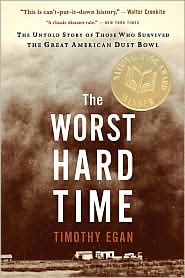
It may sound like the U.S. in the 21st Century, but it’s also our country on the brink of the Great Depression. It’s a story told in the book “The Worst Hard Time,” by Timothy Egan. I highly recommend this National Book Award winner to you. It is a fascinating glimpse of a time that has vanished from all but the longest memories. And it offers great insights into today’s markets and economic climate.

Does that mean I think that America is on the slippery slope of a Depression? No, there are differences, too. But the similarities make for great lessons that can help all of us today.

A Shot at the American Dream

Egan’s story starts in the last free land in America – the Oklahoma panhandle. After the original (native) inhabitants were chased off, settlers could stake out up to 640 acres and take their shot at the American dream.

That part of the country – including surrounding areas of Texas, Colorado and Kansas – was marginally farmable land that marketers palmed off on unsuspecting new arrivals, the kind of folks who believed in tomorrow because it was all they had in the bank. As Egan explains …

“Hope died the first time people laid eyes on Boise City, Oklahoma. It was founded on fraud. Even the name itself was a lie … from the French word le bois – trees. Except there was not a single tree in Boise city. Nor was there a city. On Boise City’s imaginary streets, the buyers found stakes in the ground and flags flapping in the wind. No railroads. No tracks. No plans for railroads. No fine houses. No businesses. Worst of all, the company did not even own the land that it sold.”

Despite this inauspicious start, people did scratch a living from the land in Boise City and other towns and hamlets in the panhandle. Home was often a hole dug out of the sod, covered with boards and shared with tarantulas, snakes and so many centipedes that they crunched underfoot.

“The flattest, driest, most wind-raked, least arable part of the United States was transformed by government incentive, private showmanship, and human desire from the Great American Desert into Eden with a haircut. Settlement was a dare, on a grand scale, to see if people could defy common sense.”

But it was a life, and for many, the only home they knew. And for a while it seemed that heaven smiled on this venture – a decade of wet years made farming in the panhandle a breeze.

New technology reshaped the world of the 1920s – for farmers, the ride of choice was the tractor. In the 1830s, it took 58 hours of work to plant and harvest a single acre. By 1930, it took only three hours for the same job. A tractor did the work of 10 horses and took a lot less maintenance.

In their eagerness to reap as much of a profit as they could, the farmers plowed the tough prairie grass under and planted wheat. With the price of wheat at 80 cents a bushel, they reaped profits.

The problem started in 1915, when, with a war in Europe raging, the government guaranteed the price of wheat at $2 a bushel. The person in charge of this program was named Herbert Hoover. You may have heard of him. Thanks to Hoover’s government largesse, soon every idiot who could scratch a stick in the ground was trying to wrest his fortune from prairie soil.

This was no flash-in-the-pan bubble. It lasted 14 years.

By 1926, the self-described Wheat Queen of Kansas, Ida Watkins, told everyone she made a profit of $75,000 on her two thousand acres – bigger than the salary of any politician, and more money than any star athlete but Babe Ruth himself.

“Life in America in September 1929 was almost too sweet, too bountiful, too full of riches,” Egan writes.

Before the wheat boom, banks refused to lend to farmers west of the 98th meridian on the grounds that it was “too dry.” Then Congress passed the Federal Farm Loan Act in 1916, and banks offered 40-year loans at 6% interest to any man who had a farm to work.

The farmers turned around and used that money to buy tractors, which in the good times provided more than enough income. And more and more land went under the plow.

All good things must end. By 1929, America had a grain surplus. Prices crashed … but the farmers still had loans to pay.

The only way for someone who made $10,000 in 1925 to duplicate his earnings in 1929 was to plant twice the amount. At least, that was the theory. Soon, unsold wheat piled up next to the railroad track. By 1930, land that once brought an income of $4,000 now brought only $400!

What’s the Worst That Can Happen?

And things got worse! The price of wheat actually went to ZERO – that’s what farmers were told they would get if they brought any more of that damned grain near the station.

Since farmers had no income, they couldn’t repay loans. 1930 saw the first widespread bank failures. The town thrifts closed their doors forever, taking what little money farmers had left with them. And then, that same year, the weather changed. The marginally farmable land of the panhandle could produce a crop of wheat during wet years, but that part of America tipped into a full-scale drought. The land simply dried up and blew away.

But it didn’t go peacefully. Instead, dust storms raged across the landscape. From the first-hand descriptions, the best I can come up with is a dust storm is like being forcibly stuffed into an industrial clothes dryer and tumbled around with a load of dirt … only 100 times worse.

The clouds of dirt would pile up 10,000 feet high and march across the prairie, looking, as one eyewitness recalled, like a range of mountains on the move. The storms blew out windows, buried cars and tractors, fried food with static electricity caused by all that dirt rubbing together, suffocated animals where they stood and filled the lungs of every living thing. The storms were killers of animals, men, women and children.

Black Sunday

One storm, in 1934, blew up a great rectangle of dust from the Great Plains to the Atlantic, 1,800 miles wide, and laden with 350 million tons of dust – three tons of dust for every American alive at the time.

The worst storm, known as Black Sunday, hit on April 14, 1935, and carried twice as much dirt as was ever dug out of the Panama Canal.

Faced with nature’s furious onslaught, many people ran for their lives. Ten thousand people a month fled the Great Plains, the biggest single exodus in American history. Still, many others stayed … either too stubborn or too poor to move along.

The Dust Bowl was the physical manifestation of the nation’s financial and emotional sickness, problems that turned the election of 1932 into a lightning rod for “change.” The candidates talked about being the real agent of change. Sound familiar?

Vote for me, I’m an Agent of Change!

The Republicans stuck by their President, Herbert Hoover. Hoover believed the cure for the Depression was to prime the pump at the producer end, helping factories and business owners get up and running again. Goods would roll off the lines and prosperity would follow.

The Democrats had two main candidates.

One, William "Alfalfa Bill" Murray (right) was born in Toadsuck, Texas, but rose to become Governor of neighboring Oklahoma by railing against what he called “The Three C’s – Corporations, Carpetbaggers and Coons.” With the Presidential election looming, populist Democrat Murray ran for the nomination on the “Four B’s – Bread, Butter, Bacon and Beans.” The problem, he said, was that America had gone soft.

Half the country was going hungry – Murray’s message resonated. They also liked that Murray hated socialists even more than he hated corporations.

The other Democratic candidate was an East-Coast swell named Franklin Delano Roosevelt. FDR’s platform was to give people jobs with a huge public works program to build America’s infrastructure.

FDR beat Murray on the third ballot at the convention. Outraged, the titan from Toadsuck switched party affiliations to Republican. But he found himself on the wrong side of history.

FDR is famous for getting America through the Depression. Along with Social Security and other landmark programs, much of his energy was focused on stopping the Dustbowl, which spread like a cancer in America’s heartland.

At its peak, the Dust Bowl covered one hundred million acres. By the end, some scientists estimated that more than 80 million acres in the southern plains were stripped of their topsoil.

But with FDR’s leadership, the problem wasn’t insurmountable.

  • Four million acres of farmland were abandoned – the farms bought up and the people moved away.
  • Young men were paid a dollar a day in the Civilian Conservation Corps to plant trees from the North Dakota border with Canada all the way to Amarillo, Texas.
  • A government program taught farmers a new way to till the soil and farmers agreed to abide by strict soil conservation standards.
  • New technology allowed those farmers who remained to tap the Ogallala aquifer – a subterranean body of water as large as Lake Superior – in even the driest times.

By these combined efforts, the Dustbowl was tamed. Thanks to these and other new programs, the country emerged from its economic slumber. Here’s what I think we can learn from history

Lessons from the Dustbowl

Good laws are good for business. Hoover said regulation was the wrong thing at the wrong time, and would slow down the recovery. His opponent, FDR railed against crooked bankers and called for more regulation. The public weighed the facts and sided with FDR. His bank holiday and subsequent regulation restored America’s faith in his banks.

Last week, we just saw the government pony up $30 billion of taxpayer dollars to enable one bunch of sharks in pinstripe suits to buy another. Some of the financial instruments that got Bear Stearns in trouble are so complicated that ordinary people can’t understand them. I think it’s time for more regulation, not less.

Not all change is good! Can you imagine what this country would have been like if racist demagogue William Murray won the 1932 election?

All the candidates in the current Presidential election say they’re agents of real change. Senator John McCain is relying on former Senator Phil Gramm as his chief economic advisor. Gramm, a long-time foe of regulation, is one of the people responsible for letting unregulated institutions — the “shadow banking system” – take over the roles traditionally filled by regulated banks. In other words, the current banking crisis has his fingerprints all over it.

Sen. McCain may want to reconsider his reliance on Sen. Gramm. That kind of change we don’t need.

Bull markets can end with a bang. The 1929 bull markets in both grain and equities ended rather suddenly, when everything looked GREAT. This is a reminder to all of us to keep one eye on the exit even in the best markets.

That said, I don’t think we’re anywhere near the end of the current grain bull market. After falling hard and fast last week, grain prices are moving higher again.

Why? This time around, US farmers aren’t just feeding America. They’re feeding the world. And the world has never been hungrier.

World wheat inventories are expected to fall to 110.4 million metric tons in the year ending May 31, the lowest since 1978, the U.S. Department of Agriculture said on March 11. U.S. supplies may drop to 6.6 million tons, down 47 percent from a year earlier, the USDA said.

Meanwhile, floods in the nation’s midsection are delaying soybean and corn crops. And out in the old Dustbowl, parts of western Kansas, the Oklahoma Panhandle and West Texas received so little rain in the past month that the winter wheat crop may be hurt.

And it’s not just grains that are looking good. Check out this chart of the CCI Index, an equally weighted basket of commodities. It shows the bull market that began in 2001 is still going strong.

This bull market will end someday – all bull markets do – but bull markets in commodities last an average 15 years. I think our commodity bull has a long way to go.

And that makes the pullback we’re seeing now one heck of a buying opportunity.

Labels: , ,

Check out my new gold and energy blog at MoneyAndMarkets.com

Sunday, September 30, 2007

Sunday Reading

Here's what I'm reading on a rainy Sunday ...

Merrill Lynch has turned bearish on the US economy, judging by its 10 major macro themes of the past week.

The Top 100 Ways Global Warming Will Change Your Life. Say goodbye to French wines, baseball and the Great Barrier Reef. Say hello to massive amounts of mosquitoes, the northwest passage and hurricanes ...

... and someone alert Stephen Colbert:
More Bear Attacks. Earlier this year, Moscow warned its citizens to beware of brown bear attacks. In Russia, it's been too hot in the winter for bears to sleep. When bears can't hibernate, they get very grouchy and become "unusually aggressive."[Der Spiegel]

Over at Big Orange HQ,
EmperorHadrian discusses problems with the US Constitution and the Roman constitution in Hadrian's Forum: Flaws in the Design of the Roman, US Senate; US Constitution, Part 1 . How are the two related? Well, when America's founding fathers were tinkering with a constitutional framework, one of the models they used was the Roman Republic. The whole series by EmperorHadrian is very good.

By the way, I'm watching HBO's Rome series on DVD. my wife is watching it too, albeit often with her hands over her eyes during the especially gruesome parts. This series will rid you of any fantasy that Rome was an idealized utopia. We just finished disk 3 (out of 6) of the first season. An acquaintance at work told me: "At the end of the last disk of the first season, there is a scene of violence that will make your wife wince, you will laugh, and you'll remember me when you see it." Well, now I MUST watch the whole first season!

Here's what we might be driving in the not-too-distant future: The Hypercar.

Other news ... China Investment, $200 Billion Sovereign Wealth Fund, Begins Operations China Investment Corp., the nation's $200 billion sovereign wealth fund, starts operations today as the government seeks to boost returns on the world's biggest foreign-exchange reserves.

U.S. Stocks Post Biggest September Gain Since 1998 After Interest Rate Cut U.S. stocks rose this week to complete the steepest September advance since 1998 as the Federal Reserve's interest-rate cut helped energy and raw-material companies lead the market's recovery from a summer rout.

Dollar Falls to Record Low Versus Euro on Speculation Fed Will Cut Further The dollar fell to the lowest against the euro since the 13-nation currency's debut in 1999 as slowing growth and inflation increased speculation that the Federal Reserve will cut interest rates a second time this year.

Gold Rises to Highest Since 1980, Extends Rally, on Dollar Drop, Oil Gain Gold rose, extending a rally to the highest price since January 1980, as the declining value of the dollar and surging energy costs boosted the appeal of the precious metal as an alternative investment. Silver also gained.

Wheat Rises, Extends Rally to Record, on Smaller-Than-Expected U.S. Supply Wheat rose, touching a record high for the 23rd time in the past three months, after the government said U.S. production and supplies were smaller than analysts expected, reducing already-low global inventories.

Corn, Soybean Futures Fall as USDA Report Shows Unexpected Drop in Demand Corn fell the most in two months and soybeans dropped from a three-year high after a government report showed unexpected declines in demand for the two biggest U.S. crops.

Rainy Weekend Gaming

It's been raining and we hosted a game night at our house last night. Here's what was on the table last night and this morning ...

#1 Incan Gold (Diamant). This game is easy enough that the 5-year-old can grasp it, and it finishes in 15 minutes. Players venture into a lost Incan temple by turning up cards from a deck, sharing the gems they find on the way down. Before the next card is turned up, you have the chance to leave the temple and stash your finds, including any gems you get on the way out. You can also grab artifacts for even more money.

Why would you leave? Because the deck also contains hazards -- snakes, flames, mummies, spiders and rockfalls. When a duplicate hazard turns up (such as a second rockfall), anyone left in the shaft is killed and loses the gems they got this turn. The trick is, the more players that leave, the bigger your share in the next card will be.

The game, invented by elite game designer Alan Moon, was called Diamant in the original German, but redesigned for the American market as Incan Gold.

#2 Monsters Menace America. You can find this at Toys R Us for about $25.

Each player is one of six Giant Monsters, stomping across a map of the USA in search of cities to destroy. The monsters run the gamut from the classic (enormous lizards and gargantuan apes) to the slightly more unconventional (giant walking eyeball), and each has its own set of attributes and powers.

Ingeniously, everyone also controls an arm of the military, which can be used to attack and weaken the other monsters on the board. The battle escalates until all the monsters duke it out in a free-for-all, mano-a-monstrocity Monster Challenge.

#3 Rummikub. This one is too advanced for the 5-year-old, but the 8-year-old plays it to win. Similar to the Rummy that you play with cards - you try to get rid of all your tiles by forming numbers into runs of 3 tiles or more, or 3 to 4 of a kind. The colors of the numbers on the tiles are like card suits. This game may start rather uneventfully, but when the players start putting more and more tiles in play, the options for your upcoming turns can become more complex, challenging, and exciting

#4 Jenga. The classic tower building game is a challenge for all ages, and the 5-year-old is especially good at it (he has no fear, and great hand-eye coordination). The tower consists of 54 wooden rectangular bricks, in layers of 3, placed at right angles to each other. Each player in turn, removes one brick from anywhere below the highest complete storey and places it on the top of the tower, at right angles to the blocks immediately below it. A complete 3-block storey must be completed before starting another. Only one hand may be used at a time.

#5 Horse-Opoly. This is my 8-year-old daughter's favorite game, but I won it this morning. It's a property trading game based on our buying different breeds of horses and setting up bales of hay and barns on property groups. My token was the horsefly.

Labels: , , , , ,

Check out my new gold and energy blog at MoneyAndMarkets.com

Monday, September 24, 2007

The Debt Bubble and the Downfall of the Republic

HERE is a fascinating essay on how debt bubbles can contribute to the downfall of a republic. The republic discussed in the essay is Rome, but you can draw similarities between the late Roman republic and the United States all day long.

Some similarities that pertain to this discussion …

  1. Both had housing bubbles
  2. Both had a middle class under stress
  3. In both, cheap foreign labor (slaves in Rome, offshoring in the US) drove down working wages and caused massive economic realignments
  4. In both Rome and the US, there were safeguards to prevent tyranny

In Rome, those safeguards failed. In the US, the story is still being written.

Read the essay by CLICKING HERE.

In related news, I can recommend this book ...
Finally, I'll close this with how Jugurtha famously described Rome back in the day: "A city for sale and doomed to quick destruction, if it should ever find a buyer."

Does that remind you of any famous American cities?

Labels: , ,

Check out my new gold and energy blog at MoneyAndMarkets.com